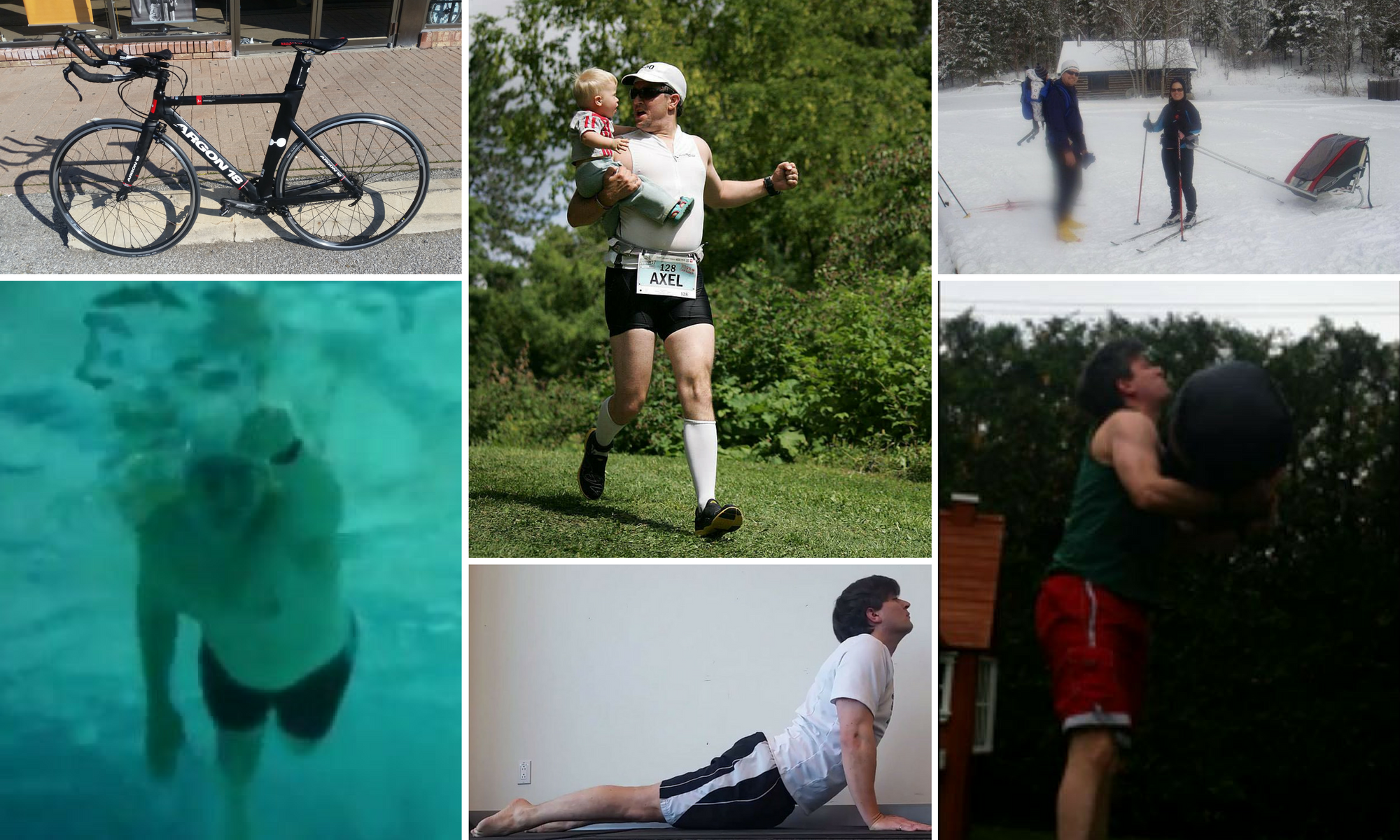
Race Recap: Bracebridge Olympic Triathlon 2015

Bracebridge is a great race; I thought so when I did it 2 years ago, and this year confirmed it.  In fact, I’m now wondering what was wrong with me that I didn’t do it last year – what probably seemed like a good reason at the time wasn’t.


I went to bed the night before with pain in my right shoulder, and I woke up with a tightness in my right hamstring, but luckily both were long gone by the time I had breakfast (bagel with peanut butter, apple, and 2 cups of coffee) and hit the road.  
Breakfast


Due to logistical concerns that I won’t bore you with, I was travelling to the race solo.  Though I love having a cheering section, and there were lonely parts of the day, I did appreciate being able to focus like a laser on being organized before the race.  Having gotten to the site with a little under an hour to spare, I still didn’t get everything perfect.


From the “Don’t Do Anything New on Race Day”

  • Somehow, I had left my Saucony Triumphs in the gym locker room at work, and I couldn’t access it on a Saturday while packing.  Luckily, I keep a pair of Mizuno Wave Riders with other running gear in my desk for emergencies (like, I forget to pack running gear) and I’ve used them mostly for treadmill runs.  So they were my shoes for race day.
  • I dropped a lot of cash on aerodynamic hydration accessories.  While I also got a double bottle cage for my seat-post, I focused on a hydration system that would let me drink while riding.  I’m pretty proud that I got it installed correctly, as I’ve seen pics of some jury-rigged setups in some triathlon Facebook groups that would make MacGyver puke.  At least, I thought I had it correct; can you see what I did wrong?


I won’t tell you yet, you’ll find out around the same time I did if you keep reading.
Race Site


Other misses

  • I did do a small swim warm-up to make sure the wet-suit was on properly, but ideally I would have done even more swimming before the race.  I crossed the river and back, that’s it.
  • I hadn’t cleaned and oiled my chain the day before, but I had inflated my tires.
  • I packed both gels I planned to have on the race course in my race belt, and set up my running shoes in transition with laces untied, but the silly part is that I thought I hadn’t,  and ended up fretting over it a little during the race.


Besides actually having a swim warm-up, which never happens to me, the other big hit for me was being able to make two trips to the port-a-potty before the race, and not over-hydrating, which meant not having to take any pit stops during the entire race.  Let’s break down the legs:
A view looking toward the Swim Exit


Swim

Bracebridge maintained its usual format of having a seeded swim start.  You simply line up by bib number.  Marshals got everyone organized in batches of about 50 people at a time, and it looked like everybody tried to find people close to them in number so it made things really straightforward.  Everyone wore red bathing caps, so there was no identifying your age group by colour, but I still like the format, and I think having different colour bathing caps might confuse people into trying to get into waves.  When you reach the front of the line (the end of the dock – you are already in the water), the final marshal calls out your number to confirm (I was 107), and finishes the countdown which is 5 seconds from the previous swimmer and you’re off!


The first part of the swim is with the current.  I honestly think the current was negligible; someone had commented that they’d seen leaves on the surface that “weren’t in any hurry”, and I couldn’t see much difference in pace from the downriver part to the upriver part.  There was no line of sight between the start and the turn-around, so sighting to the next buoy was important, and also was a great way to prevent collisions, but you didn’t have to sight too often.  I had the sinking feeling that I wasn’t pacing myself well, and I had to make a persistent effort to calm myself down and not swim too excitedly, so that I’d have a good pace on the second part of the swim.


On the way back, sighting became nigh impossible.  The sun was reflecting off the water and directly into our eyes.  Sticking close to the shoreline seemed like a good idea because the current would be weaker, and it would keep me on the right side of the buoys, so as long as I was seeing dazzling sunlit water ahead of me, I figured I was doing fine.  Besides a minor bump or two with other swimmers, the rest of the swim was uneventful.  I could swear I saw some bikes whizzing by along the river, but when I look at the maps, the bike course did not go past the North shore of the river. I still have issues with the seam of the wet-suit bunching up by my neck as I swim, which causes a lot of irritation and makes me lose time when I stop to re-adjust it.  I need to find a fix for that which won’t stop me from being able to open the zipper and take off the wet-suit when I hit transition.   I finished in 28:12, and that gives me an official pace of 1:52/100m which I’m pretty happy about.  The thing is, that’s based on 1500m exactly; my measurements show 1575m in 27:42 which gives me a crazy pace of 1:46/100m!

Courtesy of MultiSport Canada


Transition 1


My biggest challenge in transition seems to be getting the Garmin off my wrist before pulling off my wet-suit, only to put the Garmin back on again.  I just don’t like the idea of the wet-suit getting damaged by me trying to fit the watch in under the sleeve.  Other than that, I think it went pretty well, as 2:35 is actually a pretty good T1 time (in fact, it’s a personal best!).  I tried to take a sip from the straw of my aero-bottle while running the bike out to the mount line and nearly knocked a tooth out… I won’t try that again.


Bike


I was so excited to take Sable (see here for the bike name explanation) out for the first race?  Are there words sweeter to say than “on your left”?  Again I think race excitement was making me a little aggressive with my pace at first, but I think I brought the pace/effort down well enough without slacking either.  As I passed some athletes, I looked at their gear and their muscles and began to doubt whether passing them was the right thing to do.  Still, if the speed I wanted to go at was faster than I needed to go to stay safely behind them without drafting, I really did need to pass, didn’t I?  


One notable… observation, shall we say? I passed a female racer who’s tri outfit left something to be desired in the opacity department.  Remember that Lululemon controversy? They were like that.  Now this was a custom kit with a team name or something on them, but I felt bad about the view I had, and again, she wasn’t really going at a speed I wanted to match, so I passed her.  Guilt absolved… until I hit a hill and my chain popped off.  While I was replacing it she passed me and I went through the whole scenario again.  Twice this happened.
See how the front comes into a point?


Sometime in the last 15 km or so, I looked down at my aero-bottle and noticed that the front had a flat surface facing into the wind.  That’s not aero-dynamic!  I do believe that I mounted it backwards, although I thought I’d prefer having the main chamber closer to me (there are two different chambers which can be used for different liquids, or the inner chamber can be used to store ice to cool the outer chamber… that’s what I did on race day).


My overall goal, one I’ve been chasing my entire triathlon career, is to average speed over 30 km/h.  In spite of some tough hills and stopping to place the chain back on the ring twice, I achieved that goal… as long as you count the course as 42 km which it was (thanks to a last minute course alteration that was made for racer safety).  In the books (i.e. Sportstats Website) doing a 40 km course in 1:23:09 makes for 28.9 km/h.  Drat.


Transition 2


I noticed heavy legs as soon as I dismounted.  With my cleats in a new position on the sole of my feet, I was a little unsteady heading back to my space on the racks.


This is where I got two pleasant surprises: my running shoe laces were untied so I could do them up right and quickly, and I had packed the second carb gel into the same pocket as the first (instead of on the opposite side, as I intended), but I still had it on me and wouldn’t waste time going to my tri-bag (which was off to the side, as Triathlon Ontario rules dictate, which I found out at Lakeside last year).  I forgot to wear my visor, but ate the carb gel on the way out of transition.  Time elapsed: 2:13.  I should have gotten that under 2 minutes.


Run


My legs were still heavy as I headed out of transition, but I knew that would pass, more or less.  I was 3 for 3 on being a little aggressive with pace at the start; I could see my heart rate was too high, and I wanted to finish strong.  The run course was quite enjoyable as it followed the river and trees provided plenty of shade.  There were plenty of aid stations with water or HEED available every 1.5 km or so.  By the time I was 3 km in, I felt quite settled; my pace seemed to be hovering close to 5:30/km, which was better than I expected.  My legs were hurting, but I noticed that they were still responsive – when I told them to move, they moved and I kept good form.


As I closed in the last few kilometres, I saw the promise of a 55 minute finish, but again, the course was a little long, and I completed 10.43 km in nearly 56 minutes.  I had thought about doing a cartwheel or something goofy across the finish line, but when you’re chasing a time goal, there’s no room for fooling around.
Courtesy of MultiSport Canada


I had two goals for this race overall going in, and beforehand I thought they might be at odds with each other:


  1. Use it as a ‘B’ race to work on transitions and other race-day logistics
  2. Beat my previous time at this race, and maybe, thanks to a heavy training load this season, achieve a Personal Best for the Olympic Distance.

I’m really happy to have achieved both of those things.  While the new PB makes me happy, I needed the confidence that I know what I’m doing in terms of technique and strategy to carry me forward to the Barrelman Triathlon.


What Kind Of Changes My Bike Underwent From An Aero-Fit

I’ve been wanting to write up about my experience getting an aero-fit at BikeZone Mississauga with Coach (Kris) Kurzawinski for some time now.  When I finally had some blog post writing time available, it was shortly before the Bracebridge Olympic Tri weekend, and I wanted to get my announcement about RODS Racing out there first.

The next thing I’m going to spend time on writing will be my Bracebridge Race Recap, but fear not! As usual, I have a cunning plan to provide you with the relevant info, without spending time churning out text and photos.

I’ve been playing around with Periscope, and though I’ve made some fairly bad (e.g. a live broadcast of a bike ride where you couldn’t hear a word I was saying thanks to wind and vibration), I think this one turned out OK.  I think only a few people saw it live, but I figured out how to edit the video so everything is right side up, and put it on YouTube (My Channel – Please Subscribe!).

Here it is.


A Special Announcement

I’m racing in the Bracebridge Olympic Triathlon on Sunday… but that’s not the announcement.  A charity I’ve been following (and supporting) for the past year or two, has opened up applications to their team, and on the spur of the moment, I’ve joined the RODS Racing Team.

Donation link below.

I’ve seen first hand how a child with Down syndrome can flourish and thrive with a loving family’s support.  I’ve seen it in my own child and in the children belonging to the community I’ve joined.  Sadly, in other countries, whether because of cultural bias, bureaucracy, or simply lack of resources, children not unlike the Lightning Kid end up in orphanages, where they won’t know the kind of love that every child deserves, and you can imagine how their development wilts, as they are left in society’s furthest margins.

There are sad problems in this world that don’t have easy solutions.  This is not one of them; you see, there are parents out there just desperate to adopt these children – but the path to international adoption is not a cheap one.  The good news is that this is a problem that money can solve.

That’s where RODS Racing comes in.  Donations go to helping achieve an adoption for a child with Down syndrome from an orphanage, one child at a time.  When an adoption is successful, the next child’s adoption campaign starts.

As a member of the racing team, I’m looking to raise at least $2500 for Laura’s adoption.  I’ll be racing Bracebridge for Laura, and Barrelman too (probably while sporting RODS Racing Team apparel).

Please consider visiting my team page and making a donation.  RODS Racing is a registered charity and donations are tax deductible.  In addition to this campaign, I’ll also have other news for really cool events from RODS Racing in the near future, so stay tuned here, follow their social media accounts (Twitter, Facebook and Instagram) and spread the word for this wonderful cause.

Introducing My New Bike: Sable


sable (countable and uncountable, plural sables)
  1. A small carnivorous mammal of the Old World that resembles a weasel, Martes zibellina, from cold regions in Eurasia and theNorth Pacific islands, valued for its dark brown fur (Wikipedia).
  2. The marten, especially Mustela americana.
  3. A black colour, resembling the fur of some sables.


My new bike is an Argon18 E-80.  I’m not an expert on bike technology, but this is a solid bike with a combination carbon/aluminium frame, with an aerodynamic design that has been fully validated in a wind tunnel.  One thing I noticed in some research I did, is that for example, the front brakes are behind the fork to benefit from their aerodynamic shape; some bikes put the brakes in front of the fork where they only spoil the effect of the aero fork.  And of course, it fit my budget of $2000.00.


Argon18 is a Canadian company, which doesn’t hurt, and I’ve been playing around with red and black as an aesthetic; these things shouldn’t matter, but I can’t help myself.


So, back to the introduction, the bike is not only black, but named after a swift predator that relies on guile and skill more than raw power.  That’s why I picked the name.


Sadly, as of this writing, I won’t have ridden her yet.  I put on new SPD pedals, and when I wanted to switch my shoes to the correct adapters (I had bought both the pedals and the adapters over a year ago from a different store), it appears there were parts missing, so it couldn’t be done on the spot, and they didn’t have any more in stock.  There are some other complicating factors which I can’t go into right here, right now, but I do like the store where I bought the bike, Bike Zone Mississauga.

Between getting a proper fit, and accessories (like water bottles), I’m sure I’ll be spending more money…

Have you named your bike? What’s the silliest bike name you’ve heard?

Tri-Talk Tuesday: My Burning Transition Questions For Half-Iron Distance Tris

I’m participating in the Tri-Talk Tuesday Linkup hosted by Blisters and Black Toenails, TriGirl Chronicles and You Signed Up for WHAT? They’re talking about transitions this month.

So I’m doing the Barrelman Half-Iron distance triathlon.  I’ve been doing triathlons for 7 years now, but it’s my first half-iron.  For the most part, the only new thing is simply going longer in all three disciplines, but transition is really, really different.  I’m a member of several Facebook groups that revolve around triathlon, and there’s many other ways to access the online triathlon community, but to be honest, this post is a little rushed, so I figured rather than crowdsource and research, then write up my findings here and make an informative post, I’d simply put my questions on this very page, and let it become the forum for discussion… that’s what blogging is all about, right?


  • Should I/Can I change clothes?  In sprint and Olympic distance, my tri kit is on me from when I leave home to when I get home after the race.  Everything has to work in the water, on the bike and while running, every second spent in transition counts.  On the full distance (Iron) scale, you’re not often worrying about the lost minute you spend getting into the most comfortable pair of bike shorts (which would have been terrible in the water, but will literally save your butt on the bike), because being a little more comfortable for several hours in the saddle is worth it.  What about the Half-Iron distance though? Is it worth the time? Is it even plausible or is there no opportunity to do it without being arrested for indecent exposure?
  • Can I use my triathlon bag?  At the Lakeside Tri, I was told by an official that my bag was not allowed in the transition area.  The bag not only carries my gear efficiently, but folds out into a mat and helps me lay out everything I need to race.  In a longer race, I’m only going to need more gels, liquids, gear and accessories, and the need to keep it organized is going to be greater.  I can’t see that happening if stuff is just laying willy-nilly on the ground.  In the Course Details they seem to mention Swim To Bike Gear bags that are provided by the race.  They are numbered and used to transport wetsuits and other swim gear to the finish, so I guess that’s one question answered, but my worries about a chaotic transition area are not allayed.Muskoka5150 001.JPG
  • What kind of problems is having 2 different transition areas going to bring about?  I’ll need to think about items as being ‘only for the run’ or ‘only for the bike’, I can’t take anything for granted!
  • Will I ever spell ‘Transition’ properly the first time? I think I’ve written ‘transistion’ about a dozen times now.

Race Recap: C3 Kinetico Kids Of Steel Triathlon

The C3 Kinetico Kids of Steel Triathlon took place on Sunday, May 24th, and in a refreshing change from so many endurance events, it didn’t start first thing in the morning, leaving us time to get organized (or even get a couple of hours on the bike trainer before breakfast, in my case).  Thanks to steady stream of emails from Barrie Shepley, we knew exactly when Shark Boy’s race would start, and how much time we should leave ourselves for race kit pick-up and transition set-up.


We pulled into the parking lot of Mayfield Secondary School which is right on the border of Brampton and Caledon and unloaded.  There was a nice volunteer who offered to give us a ride to the race site in his golf cart.  It really wasn’t far, but the kids were thrilled to take a ride, and it made getting the bike there easier, since I didn’t want Shark Boy riding in the parking lot and walking a bike is always tedious.
20150524_114827.jpg


We arrived at the main race site to see festivities in full swing.  Shark Boy’s favourite song ‘Paradise’ by Coldplay (also a fave of my wife and I) was playing, and the Bouncy Castle/Wall/Slide drew the boys attention right away.  


20150524_123419.jpg


First things first though, we found the transition area and got his bike and helmet in the proper place.  I was already in a swimsuit, anticipating that I’d be getting in the water with Shark Boy.  I let him keep his shoes on for safety, and brought them to transition a few minutes before the race start, and we opted to go sockless for the sake of speed.  I had a last minute dilemma about putting him in the 6-7 age category; he’s 5 now, but triathlon rules (and body marking) goes by what age you’ll be at the end of the calendar year.  I knew he could handle it physically, but I worried a little about putting him in a higher pressure situation, and that race started a whole hour later.  The fact was that we had registered for the 3-5 year-old race, which is non-timed, so that’s where we stayed.


Then, with some time to spare before opening ceremonies and the race start, off we went to the inflatable slide.  Shark Boy knew what to do, and so did the Lightning Kid, except the whole, ‘wait your turn’ thing.  What nobody expected him to do, is climb the thing unassisted! I think he made a few sets of teeth sweat, but he always made it to the top where a volunteer assisted kids in getting over making sure they all stayed safe and didn’t land on one another.

11257014_10155538185445125_1746682509384295971_n.jpg

11329748_10155538187190125_8113979388842445893_n.jpg

10422114_10155538188060125_832889625481359445_n.jpg


Either the heat or pre-race nerves started to get to Shark Boy, because he couldn’t wait to get into the pool, and was not happy with waiting for any process or procedure that might keep a race like this organized and free of chaos.  He was even less enthused about sitting through speeches for the opening ceremonies, but luckily, his mood improved once we entered the rec complex – the swim portion took place in an indoor pool.


Each wave had only a few athletes, and it was generally one or two athletes (plus their parent/guardian) per lane, so everything was comfortable.  They had us inch up to an imaginary line where a lifeguard chair was, and wait for the start.  Hilariously, the kids’ nervousness and uncertainty seemed to spread to the parents, as several people started to ask if there would be a signal to start; as if there might not be and we could just go whenever!  That signal came, and off we went.


20150524_124455.jpg

20150524_124239.jpg

20150524_124236.jpg


Thanks to a waterproof case for my phone, I got a few snaps in the pool as he was swimming.  As far as I could tell, he was the only one swimming without a life preserver (I had to turn down several offers).  I think we were first or second to the end of the pool, and some volunteers helped him out while I hoisted myself onto the deck.


We headed outside, and although I had reminded him of where his bike was in the transition area, he still hesitated and had trouble finding it.  Still, once he did, we got shoes on and helmet (of course) before he picked up his bike and we headed to the mounting area, but not before another wrong turn (this time it was my fault).


I’ve experienced how fast Shark Boy is on the bike so I made sure I sprinted ahead.  I tried to get pictures, but wet fingers don’t work well on touch screens, so I missed out and figured there would be some official race photos (more on that in a bit).  The bike course was very short, once around the parking lot, and the volunteers took our bike at the dismount point.

I later heard from my wife, who was struggling (along with the Lightning Kid) to keep up with the race progression visually, that Shark Boy’s name kept being announced over the speakers, as he busted through each leg of the triathlon; out of the water, out of the pool, out of transition 1, into transition 2, across the finish line.


He really got the idea of going as fast as possible, because he didn’t bother to take off his helmet, much to the amusement of the race announcer.  I asked, and he said he was OK running with it on.   We did a loop around the grass, and through the finish gate.  First place for Shark Boy!


He wasn’t interested in bananas or oranges (he’s a bit of a picky eater), so we came round and found my wife and the Lightning Kid who hadn’t been able to see much after the swim because it went by so fast!


11112772_10155536670295125_4178494456614023647_n (1).jpg


The finisher’s picture we took makes it look like triathlon is something we force him into against his will, but I promise you he’s all smiles during the race; he just doesn’t like having his picture taken and it didn’t help that the race took place during the lunch hour.


I wish we had more pictures to show, and I acknowledge that this is a nit-pick, but the race photographers seemed to manage to get several shots of almost every kid (especially our nearest neighbours in the race), but none of the one who completed the race without physical aid from his parent, nor a life preserver, nor training wheels.  And again, he came in first place.  I’d feel bad for dwelling on the win, but really, how often do you get first place in life (assuming you aren’t Chrissie Wellington)?  We even noticed a drone taking either aerial photos or video, but I don’t know when or where they’ll be available.  


We celebrated the win with a free toy that Shark Boy picked out of a box (a giant bubble wand), balloons, and hot dogs. The C3 Kinetico Kids of Steel Triathlon is a welcoming, inclusive event, because every one asked if the Lightning Kid was racing this year, or if he would next year (it’ll be soon, with a little improvement on the bike). When we floated the idea of him being the first athlete with Down syndrome in the race next year, we found out there was a girl with Down syndrome doing this year’s race. Like I said, being the first is a rare opportunity in this world!

Thanks to the C3 Triathlon Club, Personal Best and all the sponsors for organizing such  a great event!

#WorkoutHack: Triathlon Strength Training at the Cottage

The Victoria Day Long Weekend is traditionally when Cottaging season starts.  Having a cottage (or access to one) can be a real boon to the training triathlete.  First and most of all, it’s a way to access open water swimming.  Bike and run training can be done too, though often it takes a form of cross-training since the roads can be a little rough; mountain biking and/or trail running are great, and I’m proud to say I got both of those done this long weekend.


My training schedule, however, had me down for a strength training session on Monday.  I’m in the Specific Preparation Phase 3 of the plan,  where the strength training profile is specifically geared to “Power Endurance” with explosive and plyometric type exercises.  Moreover, they focus very much on triathlon specific muscle groups and functional movements that mimic swim, bike and run.


The workouts call for 8 types of exercise:
  1. Hip extension (squat, leg press or step-up)
  2. Standing bent-arm lat pull down (bent at the same angle as during freestyle swimming)
  3. Chest press or push ups
  4. Seated row
  5. Abdominal curls (core body work)
  6. Back extensions (core body work)


#3 has been substituted with a “personal weakness” in most workouts in the book.  I still like putting in some work on my chest for the sake of balance though.  The question is, how was I going to get in a strength workout at the cottage, far from any gym, never mind one so specific?


Well, I’ll tell you.  I started off doing push-ups on the dock.  I still use the 100 Push-Ups app to give me structured sets.


Then I found a stump to do step-ups.  I had considered box jumps, but it had rained, and you should generally do box jumps onto something very stable, so the stump might not have been a good idea even if it had been dry.  For a weight, I used the Lightning Kid, and moved up to a heavy rock on my third set. (10 reps per leg, per set).


Instead of a seated row, I used the kids’ swing to do TRX-style inverted row (3 sets of 12-15 reps).


I don’t like the Standing bent-arm lat pull-down, as it seems to put my shoulders at risk.  Most recently I’ve been using medicine ball slams as a substitute, but at the cottage, I chose to split some wood – same motion, same downward stroke to help the shoulders power my swim.


I’m not going to lie, I didn’t finish that workout that day, at least not before lunch was ready.   I had scoped out a bench we use sometimes and tested it out for doing Dolphin Kicks as shown below (from this article on Daily Burn); it would have also been handy to do lying leg raises which would have fulfilled the core/ab exercise for #5.


I’m looking forward to using the cottage environment to supplement my training for the rest of the summer.


Do you have ways of turning your cottage or home into a gym in unexpected ways?

Starting A Triathlon Training Plan Before You Have To

I announced in January that I had selected a training plan for the Barrelman Triathlon (Half-Iron).  The plan is of a 27 week duration, meaning the start date of the plan was Monday March 16th.  That falls right on our family ski vacation (recap to come), but as I had mentioned in my February Goals post, I’ve been implementing the structure of the ‘Basic Preparation Phase’ for nearly a month and a half.  Here’s why this was a good idea.


Starting the Habit


  • For my program, Tuesdays and Thursdays had both swim and run workouts.  The more of these I did, the more #TwoferTuesday and #TwoferThursday became the norm for me.  Come those days, I was packing a swim-suit, running shoes, etc.  It became a fact of life, and when the real program starts, I can put my concentration into what kind of swim and run workouts I’m supposed to have (speed, endurance, etc.)
  • Any formal training program should tell you what they’re assuming about your basic level of fitness and current training volume.  These tend to be described in fairly general terms, but by pre-sampling the training program, you’ll have a better idea what you’re in store for at the outset.


Learning What Works/What Doesn’t

Tech

  • Doing triathlon training in February in Canada means a log of indoor work.  Tracking treadmill runs, was a challenge since  phone apps want GPS data (ditto a Garmin), but Samsung Gear Fit tracks well through step counting.  BUT, not if the Samsung Health App is started through the phone.  Endomondo pairs with my ANT+ Garmin HR strap, but the Samsung app doesn’t seem to, luckily, I still get some HR data through spot checks the Gear Fit makes.

Logistics/Scheduling

  • On one of my ‘twofer’ days that have a swim and a run, I opted to do a treadmill run and had asked my wife if it was OK if I did the swim in the evening after the kids were in bed which is usually “clean up the kitchen then quality time” time – then I wouldn’t need to do an early morning workout.  Then, the Lightning Kid took forever to go to sleep (and asked for me) so what should have been an 8:00 departure turned into 8:30 or later.  An evening workout runs the risk of making sleep difficult, and the truth is I was feeling exhausted (and I had the sense that a cold was coming on).  I scrapped the swim in favour of rest, since getting sick would have sacrificed more than one workout, but the bigger takeaway is that mornings might be more practical after all.
  • The training program doesn’t seem to have much in the way of rest days, at least not in the early season.  This may be a problem for a 40-something athlete like me, I may be able to work around it by turning some workouts into ‘active rest’.  The best example might be substituting a Yoga class for a weights/strength session.
  • As of right now, the first week of the plan fell on the vacation in Vermont, and I got 3 hours 55 minutes of training volume done in a week that should have been 9 hours 30 minutes.  Yet, thanks to having followed the basic structure for most of February and early March, I could pick up at week 2 without missing much, at least in theory.  What I’ll do instead, is do Week 1’s workouts (since they have some time trialing that will be used to benchmark some of my paces and performance) then move to Week 3 and be in sync.


What’s Missing

  • What I didn’t do well during my pre-sampling, is get to know the different workouts.  The table/spreadsheet has codes to classify workouts into different categories like time testing, endurance, speed, form, muscular endurance, anaerobic etc. and now that I’m in the thick of it, I find myself pressed for time to learn what I need to do for tomorrow’s (or even today’s) workout. I still haven’t transcribed everything into my own spreadsheet, but I should be OK until May or so.

Make sense? Or am I crazy (I love it when you call me crazy!)?

Motivation Monday: My Vision Board

Vision Boards are a way to maintain motivation and maintain focus on your life goals.  It’s one of those new-age semi-hokey things that I’m guilty of rolling my eyes at when I’ve read or heard of them, but I’m nothing if not open minded, and when I started making goals for this year, some of them loomed a little large, so a little extra help staying focused might be a good idea.


I made a Vision Board of the things I don’t want to lose sight of.


Let’s break this thing down

  1. Barrelman Triathlon – My first Half-Iron distance triathlon, and the biggest goal for the year.  It’ll be just after my 42nd birthday, and if you’re a fan of The Hitchhiker’s Guide To The Galaxy (like I am), you’ll know 42 is an auspicious number, so it feels good to commemorate that birthday with something big.  It’s going to take a lot of time and effort to get ready for that race, so it’s important to keep it in the forefront of my thoughts.
  2. 187.  That’s my goal weight in pounds;  back in the 90’s it was passed around as a kind of gangsta symbol (let’s not go too deep into the darker meaning of it… it’s a good weight for me and it sounds badass).  I’ve kissed that line, and moved back up a pound or two only to return to close to it.  I need to hold to the principles of the Doctor’s Diet for the majority of the time.  I think my increasing training schedule will help me even travel below that line but I need to make sure that I don’t start burning muscle by not allowing my calorie deficit to get too big on bigger training days.  And those calories, of course, need to come from the right (i.e. healthy) sources.
  3. Monetizing the blog (or at least making it a little more professional). This is the least serious of my goals both in priority and in defining what the goal is. The truth (or at least what I tell myself) is, I just like writing and I would do this even if no-one read. Still, I do get a kick when I get engagement from readers, and I enjoy when the blog generates an opportunity to try new things, and I get a wee bit envious when I see other bloggers get opportunities that have passed me by. Because writing is the part of blogging I enjoy most, when I get time to devote to the blog, I write a post. If I want to capture more opportunities (reviews, events, sponsorship), I know things have to change a little. Self-hosting the blog (on its own domain) and re-design could potentially generate things like brand ambassadorship or other opportunities. The driver is more recognition and/or status than actual money, however, I do need to keep in mind the fact that this blog is a hobby about my hobby, and will always be prioritized as such; i.e. way down the line from some of the other items on this vision board.
  4. Bicycle. A half-iron is serious enough mileage that a new bike is called for. My old bike (with aero-bars I put on myself) is not going to cut it; it’s at least 14 years old and I’ll bet the frame is a bit fatigued – I can see lateral motion in the lower parts of the frame when I pedal on the trainer. The bike in the pic is a the Trek Speed Concept, and while I haven’t decided necessarily on that particular one, I do have to admit both the old steed I’m thinking of putting out to pasture and my mountain bike are by Trek, they’ve served me well, and the Speed Concept is available at price points in the kind of range I was imagining myself spending. Plus, there’s that whole ‘Trek’ name that gets a rise out of my inner geek, you’ve seen me show the Live Long and Prosper (RIP Leonard Nimoy) next to the Rock Devil Horns… I mean it ‘Live Long and Rock On”.
  5. Resolve. My word of the year. There are bound to be challenges to all these goals, so central to achieving them is RESOLVE. I can either find a way around an obstacle (RESOLVE the problem) or show grit and determination to power through it (using my RESOLVE).
  6. Reading. Shark Boy has learned to read independently (simple words, but he does get them on his own) and obviously we want him to progress. I’m reading him a few pages from The Hobbit every night too, and it’s great seeing him get engaged by longer form story-telling (and dragons and wizards etc. too). We need him to improve his printing, and I hope I can get him do to a little writing of his own. The Lightning Kid needs to work on letter recognition and some of the basic precursor skills that feed into reading; it’s early yet, but we know it will take him longer so it’s great if we can get a head start. I’m proud of how we get outside and active as a family (and looking back at the February goals, I know we rocked them), but the more academic stuff can’t get left behind either. I’m also happier myself if I can get at least a little book reading (sorry, blogs and articles on the web don’t count) done every day.
  7. Walk The Line. I’m proud of my kids, which means I’m proud of my family which means I’m proud of our marriage. For a marriage to withstand raising children, never mind rambunctious, dynamic ones like ours, never mind if one has special needs, never mind if you’re constantly out and about as a family, it needs resilience. Resilience is built into a marriage in a similar way to how it is built into a body: it takes a variety of factors. For the body, it’s the right mix of nutritional ingredients and varieties of exercise. A resilient marriage has a similar variety of necessary components – and I probably haven’t learned them all yet, to be honest. I know respect, time for meaningful communication, affection, quality time and actual adult date nights are in there for sure. I’m proud of how well we’ve been able to stick to those things during the past 7 years. Training for a longer distance triathlon will impact all those things, I can’t deny it. What is important is that I keep to that line as closely as I can, even if I wander off it a little. I mustn’t, as Joey Tribianni might put it, let the line become a dot to me. I was going to call it Holding the Line, but then I couldn’t make a Johnny Cash reference, and you should always make a Johnny Cash reference if you’re given the chance.

Have you ever made a Vision Board? If not, what other motivational focus tools would you recommend?

Swim Workout: Thursday 300s

I did this swim workout 2 weeks ago, and I thought it might be worth sharing.  The general idea (especially the main set) is from Gale Bernhardt’s Training Plans for Multisport Athletes.  The idea is a time trial test to determine race pace and other paces that are needed for tempo-type work etc.


  1. Warm-up for 300m
  2. Do 300m of power work with hand paddles
  3. Do 3 intervals of 300m.  Try to finish each of these with completion times that are within 15 seconds of each other.  Effort should be hard, but not so hard that you’re blown up in the third set and the times are inconsistent.  Rest 30s to 1 min between intervals
  4. Do 3 sprint intervals of 50m.  Rest 30s to 1 min between intervals
  5. Cool-down for 150m
Total distance: 1800m

If you average the  time of your main set 300m intervals and divide by 3, you get a benchmark time for 100m.  Slower than this for aerobic work, faster for speed work…

Looking at the stats from my test 2 weeks ago, it seems my Garmin 910XT and I don’t agree on interval lengths. If I look at the average 100m pace for Intervals 3, 4, 5 (the main set), rather than the total times of the intervals, we see I’m not quite consistent enough; the times vary by almost a minute, when the paces should vary by about 5 seconds or less (5 seconds=15 seconds/3).

Oh well, I’ll be doing this time trial several times during the 27 week training plan, which starts soon enough…