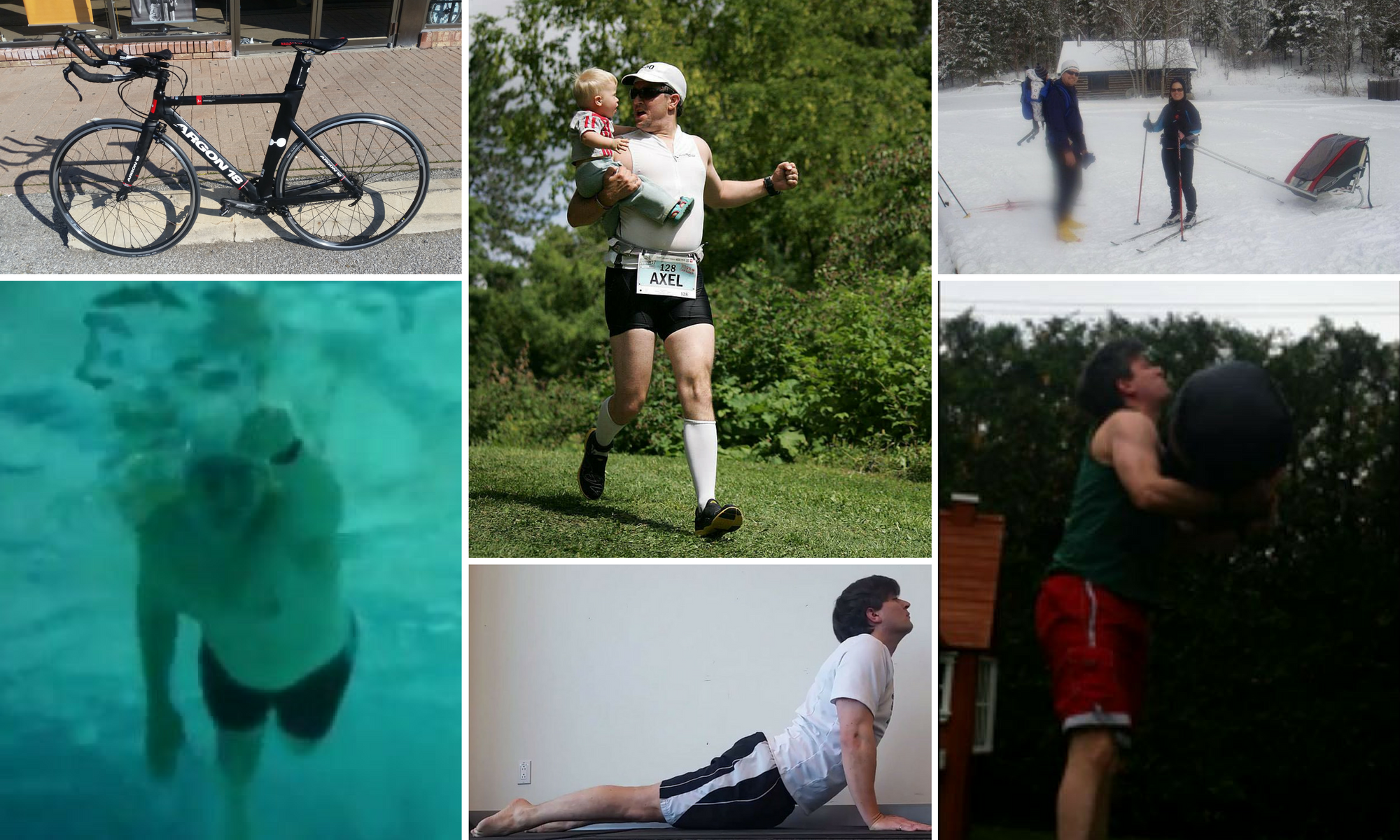
More Gravel Biking: Tour De Muskoka

One of my big motivators for buying a bike for the cottage was when I saw signs throughout Huntsville advertising a ‘Tour De Muskoka’ – this ended up being a fundraiser for the Huntsville Hospital Foundation. Rides of 93km, 54km and a gravel ride of 53km were offered, and I waffled between the latter 2 options. I’m far from an expert gravel rider, so maybe the road 54km would have been better – it also had slightly less hill climbing. On the other hand, a gravel bike is what I had, so a gravel ride is what I should do, right? The ride was intended to be friendly and open to riders of different levels (though I did sign a waiver attesting to the fact that I was ‘fit’), so I opted for the gravel ride.

The ride started in the Deerhurst parking lot, and we got a coupon for a free coffee from the in-house cafe. That put me in an encouraging mood. The ride leaders made fairly informal announcements, but we did get a police escort from the OPP along the majoro roads where significant car traffic could be expected. The 93km riders left first, then the other 2 groups left more or less together, since the first 15km or so of their routes were common to both.

The ride to and along Highway 60 was pleasant and sociable, and riders chatted amongst each other, getting to know one another. Things began to spread out on hills as riders had different fitness levels and climbing abilities, and different tolerances for high-speed downhill descents. I noted those descents, knowing they’d be big climbs on the way back.

The police officer held traffic for riders to turn left off Highway 60 to Limberlost road, and after a few kilometers along that road, the rider regrouped for head-counts, and to split the road riders from the gravel riders. We gravel riders wished them well, while bragging that we’d have more fun. Someone compared the divide to skiers versus snowboarders; I’m not sure I agree, especially because I think it would put me in the snowboard group.

At the entrance to the Limberlost Park, we got another stop to regroup and have the particulars of the more complicated sections of the ride. I had tried to scout it out during a brick workout a few days earlier and screwed that up. They apparently put up signs the next day, so I was better off this time. We did loops around Lee Lake and Peeler Lake, and for the former loop, I did stop another rider from accidentally repeating it.

It was a beautiful day, and on more than one occasion I noted the sunshine sparkling on the water of the lakes we rode past. There were also several huge Inukshuks that had been built. I didn’t stop to take pictures because I noticed I was one of the slower riders and I was self-conscious about keeping people waiting. There were some hills that were not only steep but with very, very loose gravel, so dismounting became the wisest option, and frankly, there were times it seemed like it would be faster.

I had noticed that I was at the 27km mark at the far end of the Lee Lake loop, with the Peeler Lake loop still ahead of me. I began to figure that unless there was a short-cut out of the park after Peeler Lake, I wasn’t really near half-way done. I had heard a comment that the Strava route they provided didn’t start at Deerhurst the way we did but rather about 5km into the entire course; at the time I was trying to tune out any discouraging thoughts or information.

The group leader told me after the Peeler Lake Loop that he’d be heading back to Deerhurst without stopping. I was tired and slow, but confident I could make it on my own. Luckily there were 2 other slower riders who waited for me at some of the intersections – shout out to Frank and Leslie! I’m also grateful to the volunteer who manned the aid station even when I figured she would have packed up – she even gave me some banana bread!

I got check-up texts from my wife offering to pick me up, since I wasn’t making my original estimate of a 3 hour ride, but I was determined to finish. The climbs on Highway 60 were as bad as I feared, but I just kept slowly grinding away the distance.

When your family is there to cheer you to the finish, it always feels like a hero’s welcome.

In the end, the ride ended up being 65km long. It was for a good cause, but I didn’t want to look at a bike again for the better part of a week.

New Bike Adventure: Gravel Biking

In the past, I’ve struggled with Mountain Biking. Most trails I find are too challenging, to the point of being dangerous to me at the level of expertise I have (i.e. next to none). Since moving to BC, dyke trails are often recommended, but those aren’t really challenging enough – they are mostly flat, though the gravel is too tricky for a road bike. I’ve ridden plenty of these with my Trek hard-tail, but it’s overkill (and a little heavy). So I figured a gravel bike would be my next bike.

A blue gravel bike - the Norco Search
Norco Search

My other problem is that I don’t have a bike in Muskoka so my training always suffers during the time where I’m at the cottage. When I’ve had my triathlon bike at the cottage, I have to load it into the car to bring it to a suitable road for riding. On this year’s visit, I considered renting a bike, but after I costed that out, it made more sense to buy a gravel bike. I got a good deal from the Muskoka Bike Pro Shop in Huntsville, and I’m so glad I made that purchase.

My first ride was right out of my driveway, which hadn’t been previously possible on my tri-bike’s skinny, untreaded tires. It was still very hilly, and I confess I got off the bike once or twice, not because the hill was too steep or too long, but because I hadn’t had enough time to recover from the hill before. There were more cars on these roads than I would have expected, but everyone drove safe so I was able to focus on enjoying the ride.

For my second gravel ride, I chose the area around the Lightning Kids summer camp in Novar. I had it recommended to me by Muskoka Bike Pro Shop. I found this ride even better in a lot of ways because it wasn’t as hilly, and I could really enjoy the flying, spinning feeling you can get on a road bike without worrying about any dirt roads. I think that was what was missing when I would ride the mountain bike. It doesn’t quite feel the same in terms of speed and lightness that a road bike does. This has that same lightness, but I’m not stressed when there’s a rock in the road or anything like that. I will say, washboard is still a bit of a nightmare to drive over. The route, as I said, was not as hilly. There were some nice rollers, and though I had hoped to get a 20-kilometre out-and-back done, I hit a point where the road was so steep and rocky that maybe a mountain bike would have been better after all, so I turned around and went back.

Another nice thing about this bike is that it has my first set of tubeless tires, so I worry less about punctures. The guys at Muskoka Bike Pro Shop added a sealant. I might try to do the Tour De Muskoka before the summer is out, and I think this will all put me in better bike shape for the upcoming Vancouver Triathlon.

A June of Firsts Part 3: A Ride Around Stanley Park Seawall

I heard the Stanley Park Seawall has a dedicated bike path that only travels in one direction so I thought it would be nice to ride it as a family. We had to do a pick-up in Delta in the late afternoon anyway, but it did mean our ride would be time-bound. I found lots of potential routes – while the Seawall path itself is clear, finding an accessible starting point with parking is up for some debate. Some I found started in the streets of downtown Vancouver, and bike lanes or not, I knew I’d have an easier time selling it by avoiding streets. I found this map, and parked at Denman and Georgia as suggested.

There were 2 public lots, and since I’ve had my car broken into in Vancouver before, I was a little leery. I picked an Indigo lot where people complained about being ticketed in spite of having used an app to pay for parking. Sure enough, I saw someone get ticketed while I unloaded our bikes and arrive shortly thereafter. Spoiler alert: Luckily we did not have the same problem.

On a Saturday the trails were crowded, especially at first. Whenever you’re at a standstill, it’s difficult to merge into the traffic, especially since traffic contains not just cyclists of all levels, but e-bikes, e-scooters and inline skates which all have wildly different speeds.

There were many sights to enjoy so we did stop often and had to deal with that merging challenge. Still, I wish we had even more time to really explore them. We were also blessed by the presence of public washrooms, which I didn’t know I could count on.

By far the nicest site with the biggest potential for stealing your day away was Third Beach. I didn’t go in the water but the Lightning Kid said the temperature was OK, and it was certainly a beautiful blue. We held off on getting ice cream or drinks from the nearby stand/restaurant, but maybe next time.

All three of the “June Firsts” were adventures that could have been all-day affairs. Maybe next time!

Off-Season Training Ideas for the 2025 Rainy Season

Since moving to BC, I’ve had to get used to long stretches of rainy weather. I’ve always liked a lot of diversity in my exercise and training, but it’s easier when I don’t have to worry about an upcoming event where my training has to focus on swimming, biking and running.

Sun Hang Do

The Lightning Kid and I have been practicing this martial art for the past 3 years. It’s a bit of a local phenomenon with clubs throughout BC’s lower mainland and it’s descended from/similar to Tae Kwon Do.

We recently got tested for new belts, and we’re excited to join the ‘Black Belt Club’ where we add grappling and weapons to our training. I honestly could have/should have/would have devoted an entire post to Sun Hang Do, but in the meantime here’s a video of the Lightning Kid’s first belt test, and another of us both testing 2 years later.

A clip from our 2nd most recent Belt Test

Iron Cycle

Iron Cycle is a spin studio in Downtown Abbotsford. My wife and I used to do spin classes at a GoodLife Fitness, but with the advent of Peloton, Soul Cycle and the like, spin classes have stepped up a level. The class is conducted with very low lighting, and the club provides shoes with clips and towels. The song lists are heavily curated and the instructors pump you up with their high energy levels. We come out of the class drenched with sweat, but with a feeling of accomplishment, and it’s a nice ‘date’ that doesn’t revolve around food. Keeping up my bike fitness is a good idea for the next triathlon season and it would pay dividends if I’m on a bike event for the Ski 2 Sea.

We usually do the ‘Capable Ride’, but there are also Yoga classes and a hybrid class that combines spin with stretching and strength work – I hope I can try these sometime too. And yeah, I dig the name.

Body bar

I’ve been interested in these as a piece of strength training equipment for a while now. Between strengthening for kayaking (in case I need to do it for the Ski 2 Sea) or for Bo Staff work in Sun Hang Do (see above), I think it could be a nice addition to my home gym.


Cindy + other Crossfit.

I read somewhere that the ‘Cindy’ Crossfit workout is Tom Holland’s (a.k.a. Spider-Man) favourite workout. It’s 20 minutes of doing As Many Rounds As Possiple (a.k.a. AMRAP) of 5 pull-ups, 10 push-ups and 15 squats. I can’t do unassisted pull-ups so I use a band.

This workout makes me sweat a lot, and I’ve found that I’ve improved on the pull-ups already after doing it sporadically throughout the summer. I sometimes do variant push-ups, or lunges instead of squats .


Project Climbing

Project Climbing is a bouldering gym that has branches in Abbotsford, Chilliwack and Cloverdale. The boys and I have experimented with bouldering from time to time in Mississauga, on our trip to Berkeley, California and at both the Abbotsford and Chilliwack location. Bouldering is a form of rock climbing that is performed on small rock formations or artificial rock walls without the use of ropes or harnesses. Indoors, it’s a pretty low commitment way to get a full body workout that works your stabiliser muscles and co-ordination. I’m hoping I can squeeze in a few visits to this gym and improve my skills, grip strength (a significant marker of longevity) and upper-body strength.

Rucking

I had an old backpack that I filled with old weights and kept it in my car – sometimes when there was time to go for a little walk, I’d throw it on for a bigger calorie burn. Unfortunately, while parked in downtown Vancouver (Gastown to be precise) while the Lightning Kid was rehearsing for Toronto Kids Fashion Week, someone smashed in my car’s back window to take the backpack. I was upset, obviously, but I had to laugh at the idea that the thief probably thought they’d scored a laptop, when it was just relatively worthless weight. I hope they nearly dislocated their shoulder when they snatched it. So I might spring for a high-end ‘official’ pack and use it in the same way – but not keep it in my car when parked in a bad neighbourhood.

Mamba Cycle

This would probably feel like cheating on Iron Cycle (above), but it’s apparently a fitness studio with spinning, strength circuits, and heavy bag work. I guess the latter would potentially make it feel like cheating on Sun Hang Do (also above).

Mountain Biking

I honestly thought I’d be mountain biking more regularly when I moved to B.C. It’s been hard to find trails that are appropriate for my beginner skill level. They’re either on the side of a mountain where one slight bobble would send me careening to my doom, or simple flat gravel trails. At least those are the kinds I find in our neck of the woods; I lose interest if I have to drive more than 20 minutes to find the ‘right’ trail. Furthermore, this activity is one that I’m unlikely to do in lousy weather, so maybe it shouldn’t be on this list – but still I’m hopeful that I can find some subset of trails within the local networks that I could practice and improve my skill on.

Ski 2 Sea

Has anyone heard of the Ski-to-Sea relay race?  It’s a relay from the top of Mount Baker to Bellingham Bay, done in seven different legs: cross-country skiing, downhill skiing, running, road bike, canoe, cyclocross/gravel bike, and sea kayak.  I heard about it (or at least, a now defunct Canadian version) years ago and had it on my bucket list, but I realized last year that now I live close enough to give this a try without having to spring for airfare and shipping equipment.

I’m not in shape to try it the next iteration, so I figured I’d start trying to build a team for **next** year, that is, May of 2026.  A team needs to be from 3 to 8 people (less than 3 is logistically impossible anyway).  The link to the event site is here: https://skitosea.com/

Each leg of the race has some details that one should be clear on – for example, the downhill ski portion has a climb so it would be best for someone with backcountry ski gear for climbing.  Stand-up paddleboards are not allowed on the canoe or sea kayak portion.  No aerobars are allowed on the road bike portion. I’ll examine each leg and rate how plausible it is for me to be a candidate for completing that leg as part of a team.

Leg 1: Cross-Country Skiing (Length: 6km)

Cross-country skiing is one of my favourite sports (check the receipts!). I’ve been doing it since I could walk, and the distance isn’t too onerous. The terrain will probably be tough (intermediate to advanced according to the description) and being the first leg means getting up extra early for various logistical reasons. I just got some new skis this year so I can work on my skating (which is banned during the first 100 yards of the race), so this feels like an area I can shine in.

Plausibility: High

Leg 2: Downhill Ski/Snowboard (Length: 4km)

This sounds like a no-brainer, but unfortunately, there is a portion where you must climb to the top of a hill – over 1000 feet of elevation gain! I thought this required climbing skins and back-country skis, but according to this year’s rules that kind of equipment isn’t allowed. So I guess it’s just a matter of toughing it out in heavy ski boots, and the rest is all downhill, literally.

Plausibility: Medium

Leg 3: Running (Length: 13km)

13 km is beyond my current running endurance, but it is something I could train up to. Mountainous terrain (though it is a road run course) adds extra challenge. The problem is, in a group of 3-8 people which the relay demands, running is one I imagine most people would want to have for themselves.

Plausibility: Medium

Leg 4: Road Bike (Length: 66km)

Seems simple enough for a triathlete, right? It’s even a net downhill! However! Aero-bars are only allowed in the competitive division, so I’d be riding my old road bike might be the better option. There are also no course markers, so having a good familiarity with navigating the course is important. Last year my son and I failed to complete a 50 km bike ride due to some wrong turns on a fundraiser, so that shakes my confidence a little.

Plausibility: Medium

Leg 5: Canoe (Length: 30km)

I know how to canoe, but I don’t have one in BC, and I don’t relish getting strong enough to complete this leg. It is completed in a team of 2, which further complicates training.

Plausibility: Low

Leg 6: Cyclocross (Length: 18km)

I’ve flirted with Cyclocross a little, and always wanted to get a Cross bike. Even if I didn’t, a Mountain bike can be used.

Plausibility: High

Leg 7: Sea Kayak (Length: 8km)

While I don’t have a kayak in BC, I’d be willing to consider getting one and possibly training myself up for this event. Still, getting time on larger bodies of water might be difficult.

Plausibility: Low

The Hidden Event: Logistics

The ideal team has 8 people – one for each event, except canoeing which has 2. This has the simplest implementation, since everyone on the team has one starting line they have to be at (on time), and one event to be competent enough to finish. I think it might take a little of the ‘multi-sport’ fun out of it, though. Any fewer team members (to a minimum of 3) and somebody has to shuttle between events after finishing a leg. The race demands certain road closures, and getting equipment and bodies moved around will take several vehicles (they list 3 vehicles for the 8 racer scenario).

Recruiting and managing an 8-person team has to be challenging too – ensuring everyone is trained, equipped, and informed is a serious bit of management/leadership.

If anyone reading this wants to join a team with me, drop a comment or reach out online. I might start recruiting in local Facebook groups in 2025.

Connecting All of Abbotsford’s Discovery Trails

Abbotsford has several multi-use trails they label ‘Discovery Trail’, but since there are several, shouldn’t they comprise one network? The answer was never obvious from the trail entrances, but there is a website and a map:

Still, I had struggled to really understand how it could be used to cross from one end of town to the other. Until I made a concerted effort this July to get across town. Because I knew some sections were gravel, I opted to take my mountain bike. Having a gravel bike (my next bike – the correct number of bikes to own is the number you have plus one), would have been ideal.

I wore my Shokz Open SwimbPro Bone Conduction headphones to provide music for the long ride. I filled my hydration pack with a water/electrolyte mix and I set off to find the entrance to the first Discovery Trail West of Whatcom Rd.

Scenery/Musical Highlights

The Who’s ‘Baba O’Riley’ came on as I rode into an open field “Out here in the fields… I fight for my meals.”

“Out here in the fields”

On the way home, I had to do a lot of climbing. Lynyrd Skynyrd’s “Free Bird” was playing (I guess I had a Classic Rock soundtrack for this ride). Most of the song (I’m sure you’re familiar) is slow and plodding, but right before the monster guitar solo, the singer says “Won’t you fly, Free Bird…” and that was the moment I crested a hill and started coasting down a well-deserved downhill run.

Challenges

One of the things that has kept me from being able to pursue this little project is the boardwalk West of the Abbotsford-Mission Highway has been in disrepair until this spring. I’m so glad they’ve fixed it and I’ve used it for some trail runs already. It crosses a beautiful marshy area.

Crossing the Highway itself is also a challenge – there isn’t a good crossing that is on the way, my best solution was to cross at McCallum and ride on the shoulder on the wrong side of the road until I could turn off toward the trail.

Whenever the trails peter out and you have to transition to a road, it’s good to have done your research to know which road will keep you on route to the next trail entrance. I didn’t leverage this website, but maybe I should have.

Since it’s an out-and-back, getting to the end was the climax, and then I had the long (and net uphill) ride back to look forward to, and most of it was the same scenery.

Nature Highlights

I saw 2 snakes (probably garter snakes) on the ride – it was a sunny day, and I think they enjoyed the heat. There was also a moment where I could swear a dragonfly was trying to race me – it flew alongside me for a few hundred meters.

I helped myself to some blueberries when my energy was low
The trail led through a cemetary
Riding Selfie

I’m looking forward to doing this ride again in the future – perhaps even extending it.

The Quest To Ride To Downtown Abbotsford

I’d been wanting to combine an excursion to downtown Abbotsford with a road cycling training ride for a while. Before I committed to executing the ride, I made sure to scout out the route beforehand to look for obstacles, challenges, problems, etc.

Marshall Road has a nice 2-way dedicated bike lane, but I did have challenges with Amazon delivery vehicles blocking it, and it ends right as the downtown area really starts in earnest. By the time I got to the area with the most interesting shops and businesses, I was walking my bike (in bike shoes). On the positive side, I rode along Gladys Road without having any cars to contend with and noticed some bunny rabbits that ran alongside me (instead of perpendicularly away from me) as I rode.

I had scouted out where I was going to park my bike and what I was going to eat when I reached my destination, so 2 weeks later all I had to do was make sure I was prepared. I packed my Salomon hydration pack with a U-Lock and sandals to walk around in. Of course, I also filled the hydration bladder with water and electrolyte powder.

One of the things that had annoyed me on my initial scouting ride is there seemed to be no way nicely cross Highway 11 – Sumas Way. On this attempt, I turned North after the Marshall Bike lanes ended and thought the map was showing me a secret trail. That ended up being a dead end, so I used the bridge over Old Yale.

After that, I had a pretty easy way into the downtown core, and I parked and locked my bike under the supervision of 3 upstanding Abbotsford citizens.

I grabbed lunch and a milkshake at BRGR BRGR.

I took the time to do a little shopping at the Spruce Collective – I grabbed an Abbotsford keychain, a magnetic poetry kit and some post-cards (I’ve taken up post-card writing as a little hobby – old school correspondence for the win!).

The ride home was tedious, not only because I crossed Hwy 11 the hard way (dismounting and crossing a multi-lane roadway as a pedestrian), but also because it was a net uphill, and my hydration supply had gotten luke warm in the summer heat.

Still, I’m proud of the accomplishment, and had a nice little excursion.

Best. Ride. Ever: Chilliwack to Abbotsford

I think I had the best bike ride (or at least best solo bike ride) of my life this weekend. I had the idea of riding home from church in Chilliwack – Google said there were good bike routes, so I saved one to my phone, but more on that later.

In anticipation of another triathlon training season, I decided to update my road cycling shoes. The cleats were worn down and the velcro straps were coming apart, in spite of multiple gluings.

And so I bought a pair of new bike shoes, and they had a feature called a Boa, which I was not familiar with. There’s a little dial that essentially tightens some wires that act as light laces. I was a little concerned that the wires could break and then what happens to the shoe, but they come with a lifetime warranty, and it looks like they’ll be pretty good for on and off during transitions and triathlon. And what’s nice is I can even tighten them as I ride. I found I was riding along, and I thought I could use a little bit more responsiveness out of the shoe and some tightening. So I just was able to, while I was riding along, reach down, turn the little wheel, and the shoe got tighter.

I also tested using my Shokz OpenSwim Pro’s . I had turn by turn navigation in my ear while still being able to hear cars and the rest of the environment. So I got cues as I went along. Once I was on the on country roads, I turned on the music.

The ride was just perfect. It’s the kind of thing I always wanted to do, ever since we moved to BC: doing something outdoorsy while fitting it into the rest of my lifestyle (between the kids getting tutored and going to church). The weather was beautiful. The ride was flat. I used technology to not get lost and stay motivated. I noted that much of the ride did have signs to designate the roads as part of a bike route, and in the busiest parts of Chilliwack, there were dedicated bike lanes.

I need to find more routes like this, and ideally add mountain bike rides that are of an appropriate level for me – not just flat gravel (e.g. dyke trails) nor single track on the side of a mountain where I could break my neck.

Gear Review: Shokz Open Swim Pro (Bone Conduction Headphones)

Bone conduction (or Open-Ear) headphones transmit sound by inducing jawbone vibrations, freeing your ears to hear outside sounds. This makes them ideal for women runners who, unfortunately, need to be more aware of threats when running alone. My wife has enjoyed a pair of Shokz for years, but I was intrigued when I heard of a waterproof version.

From the Shokz website: Transducers send vibrations through the cheekbones and deliver sound directly to the inner ear, bypassing the eardrum.

Overall First Impressions/Controls

I’m not an audiophile, but I had trouble believing that this technology could produce the same quality of sound as regular earphones. My favourite songs sounded the same.

The only controls are two volume buttons on the right side, and a “multi-function” on the left. The multi-function has to be pressed a combination of times to advance or go back a track, held down to enter pairing mode, etc. The volume buttons are used to power the device on/off in addition to obviously controlling the volume.

Normally I prefer to have more dedicated controls rather than memorizing combinations to accomplish basic tasks, but I can see how not having to fumble around searching for the right button when the headset is being worn is actually more practical and user-friendly.

Bike Test

My first test of the OpenSwim Pro was on a bike ride. Normally, headphones would be a big no-no on the bike, but the open ear should mean that a rider can maintain situational awareness. On this ride, the way out was mostly downhills and steep ones at that, so I didn’t listen to music at all, because I wanted my full attention on handling my bike through the turns and such. I had planned to listen to music to motivate me up the steep climbs home. Unfortunately, I remembered to turn on the music a little late, but for the last stretch, I did notice that I could hear a car come up behind me as I rode.

Run Test

I brought the headphones with me on a run around the track at the town stadium. I had the music playing while I used the bathroom before my run – what was interesting is when I used the hand dryer, I couldn’t hear the music anymore. So loud sound coming in your ears will override the music coming in through your jawbone vibrations.

During the run, I was able to have conversation with my wife when I passed her on the track without turning down (or off) the music.

Swim Test

So the headphones are waterproof, but that doesn’t mean they can connect to Bluetooth while in the water – this is made clear by the manufacturer. So for swimming, you use them as an MP3 player; remember those? You have to load MP3 or other audio files from a computer over the USB cable to the memory of the OpenSwim Pro. MP3s are getting a little hard to come by, but I still had some songs loaded on my phone (in unprotected m4a format from iTunes) that I loaded onto my computer and then back to the headphones.

The headphones convert from Bluetooth to MP3 mode by pressing the 2 volume keys simultaneously. On my first swim, I absolutely loved hearing music and the laps seemed to tick by with less boredom and tedium. The headphones hug my head and can almost be forgotten, which is a far cry from the “listening to music while swimming” I had over 10 years ago.

Other Applications

I’ve used these headphones a bit in the office as a way to listen to music or be on a call while having a better awareness in my surroundings; e.g. a co-worker wants my attention. The microphone seems to work well for calls, though I prefer noise-cancelling headphones for longer sitting periods of meetings or deep work.

Conclusion

So far, the Shokz OpenSwim Pro is one of the best electronics purchases a multi-sport athlete could buy.

Our Adventures in BMX

Whenever I’m in a new place, I try to discover what kinds of recreational opportunities are around. Back in September, I was in the parking lot of Shark Boy’s gymnastics club, when I noticed terrain of a unique nature. It was a BMX park, with bumps and curved embankments forming a course that is completed in a single lap, although it twists and folds back upon itself rather than just being a circle.

My birthday happened to fall on a Sunday, so the Lightning Kid and I decided to give it a go, while Shark Boy was at his gymnastics training. For the footage, we’ll have to consult the Lightning Kid YouTube Channel:

I was on my hardtail mountain bike, which is not quite ideal for jumps and such on this track, or maybe that’s my lack of confidence talking. We did go back once, and I wore clip-in shoes rather than the trail runners you see me in during the video. We also got a chance to witness a race to end the season and see how it’s really done, with a mechanical gate to keep the starting line honest, found at a top of a ramp by the start of the course. A rep from the Abbotsford BMX club told us they would transition to indoors, and how welcoming they were to beginners.

Unfortunately, it took us a while to get back to them, and by the time we did, the Lightning Kid had lost all the confidence and ended up walking his bike around the ‘half-track’ which is the latter segment of the indoor course with smaller bumps. Shark Boy tried the whole racecourse but found his mountain bike wasn’t well suited to the racing gate, as he couldn’t sit in the seat and stay balanced while waiting for the gate to drop. He got to try a loaner BMX bike, but he hated how low the seat was – BMX riders typically stand on the pedals for the entire ride, and absorb the bumps by bending their knees and elbows. Shark Boy seemed to be doing well adapting to the bike and a new style of riding, but apparently he hated every second of it. I thought that would be the end of our foray into this sport, but apparently, the Lightning Kid was adamant about coming back.

On your first visit, you can get a 1 day BMX membership for liability reasons, but subsequent visits mean an annual membership. I have to admit I didn’t want to spring for one just to watch him walk his bike, but thanks to some great coaching by the staff at Abbotsford BMX, he got to ride the half-track the very next visit! Looks like I’ll be investing in the official protective gear (gloves, helmet with face covering, etc) for him, but I’m not sure if it’s something I will take up myself.