I’ve been training hard, and eating (fairly) well, maintaining my weight etc. They say you shouldn’t reward these efforts (or the goals they produce) with food, as it’s kind of counter-productive. Let’s pretend, for the sake of this post, that I’ve been following that advice and have rewarded myself with a more ‘retail’ type set of gifts.
The first item is from Manpacks. (Full disclosure, that’s a referral link. You can use it to save $10 off your first purchase, and I get $10 credit if you do). Manpacks has grooming goods, underwear and other consumables that busy men don’t seem to get around to shopping for themselves. A pack arrives every 3 months, so I find it manageable to change the order to stuff I actually need. This item, Brode Electrolyte Vitamin is supposed to help you stay hydrated by providing the needed electrolytes before you get dehydrated. It’s aimed at travellers (long plane rides with that recycled air), hikers and athletes. Obviously keeping water with you is the best option, but I have found that a lunchtime run (or runch) after a morning of coffee drinking is hard on my system (I have often said that I only exist in two states: Under-caffeinated or Dehydrated) and I often don’t pack a water bottle and belt or hydration pack, so I was curious to try these. I will say that they seemed a little hard on my stomach and I experience some mild cramping and discomfort immediately after swallowing them, but I think I could notice the effect on some of my runs, especially since the weather has been getting warmer than I am used to.
I’m not exactly Mr. Compression, but with an aggressive training schedule, I’m open to trying things that will help me recover better and stay injury-free. I have a few pairs of compression socks (most of which are lousy and ineffective), and a pair of calf sleeves from 2XU. Those are all focussed on lower body, obviously, but that’s where the work is principally done for your average triathlete (like me!). Still, I took advantage of a guest sale at the Reebok/Adidas corporate store to pick up a few items, including this TechFit T-Shirt. It’s the first time I’ve had compression on my upper body, and I wore it under a work shirt after a tough strength workout (in the ‘Specific Preparation Phase 2’ part of my training program, the strength workouts are primed for ‘Maximum Strength’). I was hoping it would aid recovery so I’d be primed for a benchmark swim the next day – frankly, it felt weird. Not necessarily bad, but weird, and I kept it on for about an hour and a half. It might be better to wear it during the workout; like I said, I’m not Mr. Compression, and this stuff confuses me a little. The official description says: “techfit® focuses your muscles’ energy to generate maximum explosive power, acceleration and long-term endurance” and the next phase of the program (starting next week) focusses on Power Endurance which combines strength with velocity (including plyometric work), so we’ll see.
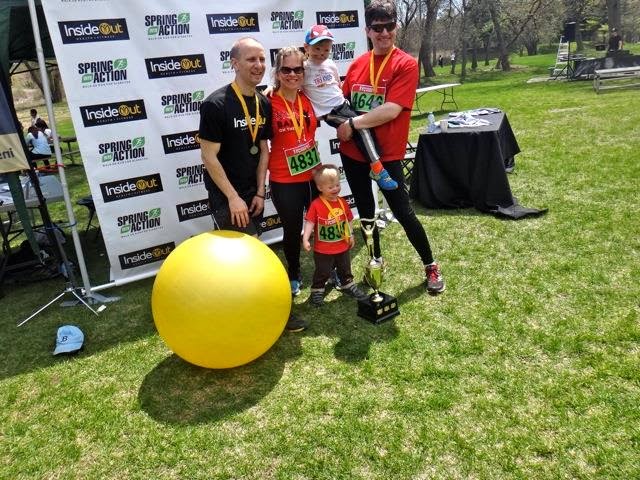
As evidenced by our outfits at the Spring Into Action 10k, I’m liking the combination of red and black. I also like hoods (it goes with the whole ‘Rogue’ theme), but I don’t really need any more warm red hooded sweatshirts, so at the same sale, I picked up this long sleeved top with a hood. It’s Crossfit branded, but that doesn’t bother me; with the warmer weather, I’m not sure how much more use I’ll get out of it till autumn, maybe for some early morning workouts.
I’m on a bit of a Saucony kick right now. My Saucony ISO Triumphs continue to serve me well, and provide the cushioning I like on the road. I’m happy enough with them that I got Saucony’s for trail running too. They kept me on the trail in the very muddy 5 Peaks Terra Cotta run and I can’t wait to get more mileage on them. Heck, even my wife is on the Saucony bandwagon…
Another product I scored from Manpacks is this Everyman Jack Face Moisturiser. I needed something for the post-shave, and I’m not looking any younger, so one way to keep the face protected is with some sunscreen (which I also like for preventing melanoma of course). I always like killing two birds with one stone when I can.
Any new stuff that you’ve treated yourself (or been treated to)? Moms out there probably have Mother’s Day Wishlists….
This was our second time running in the Spring Into Action 10 km run. After last time, I knew we weren’t going to run with both boys in the Chariot; they’re getting bigger and packed like sardines in there, and they seem to be struggling with the behavioural skill of “keep your hands to yourself” (to say nothing of feet). So this year we brought along my mother-in-law to watch Shark Boy near the starting area while my wife and I pushed the Lightning Kid (who still seems to like this sort of thing) on the run.
Spring Into Action had a convenient ‘Family’ registration package that saved me time and money. Getting extra bibs for everyone took a little extra time and effort so that I missed the yoga warm-up, but luckily, the rest of the family got to participate.
I got Shark Boy a tag and bib, because I could imagine what the outcome would be if he was excluded from the bling, even if he was happy to not run the race.
I got a chance to say hi to Barry Samuel (the organizer of the race), beforehand, and he asked a few of the families in attendance to come on stage and kick the event up with the National Anthem. If my off-key singing hurt anyone’s ears, I apologize!
We got Shark Boy to start the race with us for kicks, but as soon as he touched the starting line archway, he headed back to go play. I hope you don’t mind me skipping to the end to tell you he had a great time playing in the surrounding woods, engaging in the kind of old fashioned outdoor play that you think kids don’t know how to do anymore.
It was a beautiful day for a run and the spring colours were in full effect in Sunnybrook park.
At the 2.5 km mark the volunteers had the 5k runners turn around to complete their out and back. Last year there had been some trouble with people getting lost or off of the 10k course, and Barry had mentioned to me that they were going to do better this year. Just after the 2.5 km mark we veered up one of the biggest, steepest hills I can imagine on a run. At the top was the 3 km mark, where they had us turn around again. I was a little puzzled since I knew heading back to the start wasn’t going to add up to 10 km, and if getting 10 km was simply a matter of doing the 5 km course twice, why did we have to go up that big hill to 3 km?
All would become clear to me soon enough, because at the 1 km mark on the way back, we turned back again. At that point we had run 5 km, running another 2 back to the top of the hill and 3 till the starting point gives us a total of 10 km. A little confusing, but I have to say it was much easier to stay on the course and not get lost. This run has to compete with the Mississauga Marathon and the Toronto Goodlife Marathon for participants and volunteers so you have to appreciate that it’s a little smaller. What the volunteers lacked in numbers, they made up for in cheer and enthusiasm. With 2 km left to run, the Lightning Kid was eager to get out of the Chariot, going to the point of trying to bluff a bathroom break. 2 km is a little far for his little legs, but once the finish line was within sight, we took him out and he ran his heart out. I can tell you he wore the medal he earned for it the rest of the day. There was a post race barbecue with hamburgers (and veggie burgers and hotdogs. The buns were provided by Cobb’s Bread, who also gave out vouchers and various buns and scones (like delicious cinnamon scones which Shark Boy and I stuffed ourselves with). There was also lemonade for sale (basically for a voluntary donation to a Diabetes cause); lemonade cannot taste better than on a hot day after a run.
There was a DJ playing some nice remixes of older tunes and a clown doing face painting. Shark Boy asked for a cheetah (his favourite animal – no, I’m not changing his nickname), and the results are below.
Before leaving, we grabbed a group shot with Barry and thanked him for a day of fun, run in the sun!
Having skipped out on the Yonge Street 10K in favour of watching the kids and cheering on the runners, this last weekend was my chance to get a bib on and race. It’s the first race of the 5 Peaks Ontario Trail Racing season and I was pumped – pumped to try my legs out (especially while carrying less weight) on a new trail and push them as fast as they could go, pumped to get the kids running around their fun run, pumped to see friends.
We arrived at Terra Cotta Conservation area around 9:30 AM with plenty of time to park, pick up and our race bibs. I was pleasantly surprised to see we got some swag before the race, because I’ve missed out in the past when they’ve handed it out well afterwards, and I’ve already long since gone home.
I got to see Janice from Fitness Cheerleader finish the competitive 3 km kids race with her eldest daughter. I found Krysten from The Misadventures of a Darwinian Fail (and her husband) as well as Paul from Paul’s Inane Ramblings Then it was time for the 1 km (or 600 m in this case) fun run for kids of any age. My wife wasn’t feeling too well that morning, so we opted to encourage Shark Boy to run it on his own, while I stuck with the Lightning Kid. Shark Boy seemed a little upset at not being near the front of the starting crowd, but knowing how he dislikes standing around waiting, there was nothing for it except to encourage him to nudge his way forward before the official “1,2,3 GO!”
The Lightning Kid has been getting faster and faster and I’d already noticed in the past few months, so I was glad to see him put that to use now. I’d experienced this phenomena with Shark Boy a few years ago, but when racing with a 3 year-old, the limit isn’t so much their fitness, but their attention span. He’d stop to see who was coming up behind him, glad-hand with new-found fans (a repeat of last year at Albion Hills), and generally smell the roses. I’d be cheering and chanting “Come on! Go, Go, Go! Faster” the entire way.
Those are actually snow pants. The morning was not warm.
We were well on our way to the turn-around point (a small loop around a pond) when we saw Shark Boy already on his way back. He was smiling and really moving, so I knew he was managing the course fine, and having a good time doing it.
Then, a few minutes later, we saw him again! He had done an extra loop, and I don’t think it was exactly by accident, because I saw him try and avoid the final stretch back to the finish line only to be corrected by some marshals. Apparently he asked “Is that all?” when he crossed the finish line, so I think it might be time to enrol him in the competitive Kids’ 3k next time. I got the Lightning Kid to run the final stretch with the promise of seeing Mama and there were smiles and high-fives aplenty.
After that nice little warm-up it was time for the main event. I seeded myself at the back of the third wave and listened to the final instructions. The course was going to be a muddy one thanks to the rain and cold temperatures we’ve been having, and they asked everyone to stick to the trail and not try to go around which would widen the existing trail and erode the very forest that the area is trying to conserve. It was generally pitched as, “don’t be afraid to get dirty” and you shouldn’t if you’re trail running, but the thing is that deep mud can actually suck the shoes right off your feet (as nearly happened to a woman right behind me) and your shoes start to get really heavy as they get clogged up with mud. I still stuck to the trail, as instructed, but I found myself doing the Remo Williams run (see this video around 3:13, then watch what happens to the guy following Remo) whenever I encountered deeper mud.
Terra Cotta seems like it’s going to be a flat course, but there are definitely some hills, enough of them were wide enough to allow me to pass when other runners wanted to walk up the hills (and I didn’t, which wasn’t necessarily every time). There were a few boardwalks which the more clever runners used to scuff off the soles of their shoes as they went along and lose some of the mud weight (not to mention regain the traction provided by their treads that had been hidden by a layer of mud).
I finished the first lap of approximately 5 km feeling strong with a smile on my face. I took a gel and was determined to negative split the race. As it turns out, I did the second lap all of 3 seconds slower, and I know I really pushed myself on the last kilometre, so I’m not entirely sure what happened.
Shark Boy wouldn’t let me rest until I had seen the play area he’d discovered (which amounted to a dug out area of clay/earth), then I helped myself to snacks like Clif bars, chocolate chip cookies, potato chips and bananas. I also managed to catch up a little with Jessica from Laces and Lattes (who not only pulled a 3:15 Boston Marathon the Monday before this race, and did the Enduro course, but also did Paris to Ancaster the next day!) as well as my friend Mark Sawh, a great Toronto community runner. My official finish time was 1:09:52 with an average pace of 6:29, which I think I’m happy with. The other runners seem to set the bar pretty high, as I was the 101st man to finish and ranked 34/47 in my age category.
As always, 5 Peaks put on a fun day of running for the whole family, and though I thought we wouldn’t necessarily be able to make it to another race, we are currently pushing things around our schedule to be able to make it to the Heart Lake race on May 30th. Hope to see you there!
Following a structured swim workout can be complicated. I could probably do an entire series on swim terminology that I don’t quite have a handle on. Even when you look the terms up, it can still be a little intimidating (this is one of the better resources I’ve found so far). One of the things do understand is the idea of doing a set, like the following example:
4×100 Descending
So that’s doing 100m (4 lengths in most pools) 4 times. Each of those 100m intervals are supposed to be done successively faster. If you’re like me (and congratulations if you’re not), it’s hard to get those paces right; how do you do it, beyond just
Not too fast
A little faster
A little faster still
Fast as you can! (assuming you have anything left).
Trying progressively harder hasn’t yielded times that decrease for me when doing sets like this, but I did stumble across a way to gradually get faster and have different degradation of effort that I can mentally separate. I even gave them one word nicknames that can double as mantras, if that’s your kind of thing.
Stroll: the pace/effort of a walk in the park. You’re swimming casually, and without much concern for form (though don’t be purposely sloppy) or pace or anything.
Elegant: Make every stroke as perfect as possible. Anything you’ve been working on remembering to do in drills should be found here. You really concentrate on the best form you can manage to do for the entire interval; it takes some concentration
Mash: This feels like a hill climb on the bike (or maybe even the run); every stroke should feel like it has a lot of resistance. Push hard on every stroke, feel the power, like you would if you had hand paddles on.
Quick: This one is almost the opposite. Rather than trying to push every stroke hard, you’re trying to get every stroke over with quickly, and focus on the quickest arm turnover possible.
This shows the resulting times for 4x100m and 4x200m. Usually about 15 seconds rest between intervals.
The first time I tried this, I actually had #3 and #4 reversed, since I expected that would give me descending times (i.e. go faster). Quick seems to outpace mash for me, it may be different for you.
Disclaimer: I am not a triathlon coach, or even a particularly good triathlete. If you have one of these in your life telling you differently, more power to you – I am merely a busy cheapskate with a DIY ethic (at least in triathlon training) who likes to share his ideas and discoveries.
First things first! The winner of the free entry to the 5 Peaks Terra Cotta Trail Run is Casey Barreto! I’ll be contacting Casey via twitter/email to send her the code.
I’m participating in the #MotivateMe Monday link-up being run by Fitness Cheerleader and Running Rachel; the link-up is “a place for us to share goals, plans, successes and have each other to pick us up to keep moving forward.”
While I don’t like writing posts simply for the purpose of journaling my training for any given week, I’ve been on the Half-Iron Training Plan for 5 weeks now, and this gives me a chance to put some of it under the microscope, share some of the details and logistics with you, and crunch some numbers (math makes everything more fun, right?). It also gives me a chance to turn my Instagram into a kind of highlight reel.
Monday
I used my Dumbbell Doubles Workout for the most part, though I’m extending to 3 sets of most exercises. After that I try to address my quads since the Skulpt Aim says they’re weaker than the rest of my legs; while I don’t like using machines, I end up using the leg extension and leg press because otherwise my hamstrings get recruited too, and stay ahead of the quads in terms of strength.
Tuesday
Though Plan A was to get up at 5AM to fit in a run, we had a rough night with the Lightning Kid’s wake-ups, so I didn’t get up for that. I thought I could fit a swim in at lunch and run at night after my wife got home (I was watching the kids for the evening). I am simply not a night time exerciser, I like to wind down before I go to sleep. So no “TwoferTuesday” for me, but I did get 1800m done in the pool (or 42 minutes, since the training plan counts time).
Wednesday
Strength training days are Mondays and Wednesdays, but with an eye to regaining my lost run, I did a Burbathlon workout; that’s trail running, jumping on/over logs and obstacles, plus bodyweight strength exercises on whatever structures I come across. See the instagram video for some of what I got up to.
While TwoferTuesday didn’t happen, TwoferThursday certainly did! But, oof… this day. I had an alarm set for 5:00 AM, but the Lightning Kid beat it by 5 minutes. I got him back down, only to hear the cat throwing up at various locations through the house. By the time I was done cleaning that up, it was 5:45, and I got out of there before something else could go wrong. The result is fasted cardio; I hadn’t had any fuel prior to the run, so I resolved to take it easy. Still, I felt good, and the right tunes came on and I ended up with a pace I’m pretty happy with. I think taking some weight off has helped my speed, which was the plan all along.
What I wanted for a bike ride on friday was to do a 40 minute spin class, then tack on another 20 minutes on a stationary bike solo, while watching some Netflix. I finally finished Season 3 of House of Cards (a little disappointing, to be honest), and I was stoked to be starting Marvel’s Daredevil (who has always been my favourite superhero – and early reviews of the show are very, very favourable). I got interrupted by a very important phone call (which I really did have to take) before the spin class was over, and by the time I was done with that, I could only afford another 15 minutes of solo spin/TV watching. Still, I loved what I saw so far and can’t wait for more.
Saturday
This is the day I’m most proud of; I had to get the Lightning Kid to his soccer lessons but I wanted over an hour of running too, so I took him in the Chariot. By the time I had everything organized to go, I was running a little behind, luckily, I caught nothing by green lights, and really pushed myself. Of course, that meant by the time I’d helped him score goals and go through drills, and with a significant headwind, there was no way to do a negative split for the run home.
This was a proud moment for me, because I think the days of Stroller running are coming to a close. Shark Boy no longer has the patience for it, and at age 5, he’s doing most of his own running and biking anyway. The Lightning Kid isn’t far behind him, but the nostalgia and whatnot are making it hard to let go… in fact, I’ll be participating in #StrollerRun15… National Stroller Running Day 2015 is on May 31st! See Mom’s Little Running Buddy for more details soon.
Ideally I’d have gone to the gym and put him in the daycare to get my swim in that day; in fact, that’s exactly what I tried to do in the afternoon, only to remember too late that the gym daycare isn’t open in the afternoon. What I should have done was head there right after my run, but of course, I was a little tired. Instead, I took the Lightning Kid to the park, where I got a little bit of my own exercise in 😉
On Sunday, my wife ran the Yonge Street 10k, and we planned to take the boys with us to the starting line, see her off, ride the subway and then the streetcar to the finish line. It was a great way to spend the morning except for the fact that we were a little unprepared for how cold it was. Still, I’m proud of how well behaved the boys were, because wrangling the two of them through the public transit system and with a lot of walking to boot was an intimidating task that I wasn’t sure I could pull off. We got to see some friends who run as the “Justice League Runners” raising money for The Toronto Hospital for Sick Children, and the kids always get a big kick out of the costumes. We had a nice brunch post-race, but unfortunately, I spent the rest of the afternoon and night feeling nauseated, so I never got my final bike ride for the week in.
Totals For The Week
Strength
Planned: 2:45
Done: 2:00
The plan is a 1:15 workout for Monday and a 1:30 Workout for Wednesday. I’m past the initial ‘Anatomical Adaptation’ phase of the training plan and into ‘Muscle Stamina’. Obviously I came up short, but I do wonder what you can accomplish in 1:30 that you can’t accomplish in 0:45 if you use a more efficient, circuit based system.
Swim
Planned: 3:15
Done: 1:32
If you miss a whole day’s workout, you’re going to come up short, but again, with individual workouts of over an hour, it seems excessive. I get over 2000m done in less than an hour, but a half-iron distance swim is 1900m. I know I’m not swimming the 2000m continuously in the pool, but still, I guess I don’t get why the workouts have to be quite that long. I’m hoping that being fairly consistent and trying to keep the quality up with structured sets will be enough for me.
Bike
Planned: 2:15
Done: 0:43
Oof. The book says that in the Specific Preparation phases of the plan, 40 minute spin classes are an acceptable substitute for an hour’s ride, but missing a day due to illness really killed this goal. Bike remains my weakest discipline.
Run
Planned: 2:15
Done: 2:59
I actually exceeded the goal here, which might set off alarm bells for overtraining if I hadn’t shorted everything else. Running is still my favourite, the easiest to get done, and the most fun to keep doing once you start.
Total
Planned: 10:30
Done: 6:26
Just for kicks, I’ve also run my distances (with a best estimate of my bike) through my friend Dan’s points system. For every 10,000 yards of swimming you get a point, for every mile on the bike you get a point and for every quarter mile you run you get a point. He was nice enough to make a metric version with a spreadsheet and everything for me, but I found it easiest to just total up my meters and kilometers, then convert to imperial and calculate my points.
According to Dan, a Half-Iron training plan should get you to around 200 points a week, and I totalled 120 (42 for swimming, 16 for bike, 62 for running), so by this measure, (again) I need to step it up.
How was your week? What do you think… am I in trouble training-wise already?
The trail running season starts on Saturday April 25th, at Terra Cotta Conservation Area, and the entire Iron Rogue clan will be there. Unless you’re new around here, you should be no stranger to the 5 Peaks Race series (recaps: here, here, here, here, here and here). They’re a fun event, and super family friendly. Let me break it down for you…
They are friendly to beginners. There are two course lengths, Enduro and Sport which are 10.8 and 5.4 km respectively. If you feel you’re a slower runner, or are intimidated, you can simply seed yourself in one of the last waves, and then you don’t have to worry about being passed.
They have Clif Bars and Kicking Horse coffee on site.
Terra Cotta is a beautiful conservation area, but not as well known as some in the Greater Toronto Area. Running this race affords all kinds of ‘Terra Cotta Warrior’ puns/jokes.
Kids can run the competitive 3km race or the fun 1km race.
You will get a free high-five from the Lightning Kid
Trail running is the purest form of running; you’re closer to nature than when you’re on a sidewalk or road, and ditching the headphones means tuning into the experience of finding out what your body can do.
Thanks to me, you get a discount on your registration! Use the code AxelsTrailPals when registering online.
Not good enough? What about a free entry? One random winner will receive a discount code. You can put several entries in and the winner will be announced on Monday April 20th.
So… do you want to give trail running a try with me?
Disclaimer: I was provided with the Skulpt Aim for review purposes by Raynforest. All opinions are my own, and this post was not otherwise compensated.
No matter where you are on your fitness journey, you probably want to see some improvement from where you are now. How can you know you’re improving if you can’t measure it? Going by feel has its merits, but it can be subjective based on what else you have going on; how well did you sleep the night before, what did you eat, how much stress are you under external sources, etc.. If you measure your athletic performance numerically, i.e. how fast you can run a certain distance, how much you can lift, at least you have some quantification, but it’s still subject to those daily variables I just mentioned.
Just about every fitness blogger has a post about why the scale isn’t a good measure of health and wellness, and Body Mass Index still gets a lot of mainstream attention, in spite of being tied to weight. If an obese person whose weight comes from a spare tire of fat and a power lifter whose extra weight comes from gigantic muscles have the same height and weight, they’ll have the same BMI value, even though they present entirely different pictures, health-wise.
Body fat seems to be a decent thing to measure, most of us would like less, and certain types of fat (e.g visceral) or locations (belly) are linked to many negative health outcomes. The most accurate test of body fat involves getting immersed in a tank of water which makes it terribly inconvenient for tracking at regular intervals. Calipers are accurate if you really know what you’re doing; I got myself a cheaper more ‘entry-level’ pair last year, but I’ll be darned if I could get similar measurements from day to day. Bathroom scales that use bio-electric impedance analysis sound promising (I have one that I use from time to time), but trying to get a measurement of your whole body’s fat composition from the soles of your feet seems sketchy, and indeed there are a whole bunch of dependencies like not having eaten, slept or exercised within something like 5 hours of the measurement (when would those conditions ever be satisfied realistically?).
Enter the Skulpt Aim. You take measurements directly on different parts of the body; the general snapshot it asks for takes for measurements: right side bicep, abdominals, tricep and quadriceps. You can also measure (left and/or right) hamstrings, glutes, calves, upper back, lower back, biceps and forearms.
The Skulpt Aim also measures MQ or Muscle Quality, which Skulpt equates to IQ, except for muscles rather than intellectual ability. Higher MQ scores correlate with stronger, leaner, more defined and firm muscles. That way, you can measure how your training regimen is improving your physique and physiology, muscle by muscle.
Skulpt Aim – The Device Itself
When I got my hands on the Skulpt Aim, I was pleased to see it had a relatively simple interface. One button on the left side for powering on/off or selecting a menu entry and two buttons on the right side for scrolling through menu entries – one up, one down. The sensors are at the back, and the screen is on the front, with fairly simple menus.
Once you get your user profile set up with a few basic stats about your gender, height and weight etc. the device walks you through how to take the basic measurements including showing an instructional video, right on the device itself! I’ll admit for a split-second I thought the device had a camera, because it looked like a first-person view through it as I was lining it up with my bicep, until I notice that the bicep in question was better toned and more hairless than my own…
I’ve found it easiest to simply keep my Skulpt Aim in my shower caddy; it’s splash proof, and taking measurements after my shower (either as part of a morning ritual, or post-workout) is easy since I’m already wet, and all muscles are… *ahem* uncovered, shall we say.
Another great feature is a multi-coloured LED around the rim of the device that flashes as you scan the muscle. It changes to solid when the scan is finished. This is especially handy when you scan muscles that are hard to reach so you can’t see the screen to know if the scan is finished, e.g. calves, back, triceps. I could usually see the side edge of the device no matter where I measured, but sometimes it was easier to look in the mirror to see the flashing end.
The App
I liked navigating the app more than on the device – a smart phone touch screen is more familiar than the button layout of the Skulpt Aim, and there are simply way more options. The app only asks for one permission when you install it – access to Bluetooth so it can pair with the Skulpt Aim – rather than your location, friends list, camera, custody of your first born child that so many apps ask for, which is refreshing. Bluetooth pairing worked quickly and easily.
The Data That Skulpt Gives You
The following charts show the progress I made (or didn’t make). More than anything else, I used the ‘Total Body’ measurement which uses right bicep, tricep, ab and quad to take an average picture of your body, so I have the most data for those muscles. The big take-aways I have are that my glutes and hamstrings are the fittest (and most lean) parts of my body. Which is not too surprising for a triathlete, especially one who’s stronger on the run than the bike. I was proud of my posterior chain and hill-climbing at the beginning of the off-season, and I’ve been incorporating dead-lifts into my strength routine since last December or November, so that’s nice to see.
I made this chart myself. I know it’s a little dense.
Having quads that are much weaker (less fit according to MQ) than my hamstrings is a bit of an alarm for me. I knew I needed to get stronger on the bike, and muscle imbalances can lead to injury so I started trying to focus on isolating the quads in my strength routine since I first saw that. Overall, I’ve seen my Right Quad MQ go from 102 to 110, so that looks good.
We can also see differences between right and left sides. This may be due to actual differences between my right and left side muscles, or due to how I’m measuring the muscle. Given that I can see fluctuations in MQ and Body Fat from one day to the next consecutive day, it has to be at least a bit of both causes. The nice part is that if you take more than one measurement in a day, the progress feature of the app will report the average value of that day, so you can use the law of averages to get the best reading if you want more accuracy.
I think this device (and app) would be useful for
Bodybuilding/Fitness competitors who want a picture of what each muscle is doing over time
Runners with gait issues who need to strengthen given muscles for better running function
Triathletes who want to avoid problems in the future related to muscle imbalances
Does this device sound useful to you? What quantities do you like to track when it comes to your training?
“You know what I like about Vermont? It has better sticks.” – Shark Boy
While I have my doubts that the sticks of Vermont are of higher quality than the sticks of Ontario, Shark Boy does have a point that we were able to spend our vacation in a beautiful (fairly) natural setting at Smuggler’s Notch Ski Resort. We try to alternate our spring break between hot places and ski vacations, so after last year’s trip to Mexico, it was going to be skiing, even if this was another brutally cold winter. Having been to Quebec twice, we wanted to switch it up this year. My wife did some research at the Toronto Snow Show, and while there was heavy competition, we decided on Smuggler’s Notch due to its reputation for families and the 20% discount deal that they offered us through the show.
Taxicab Selfie on the way to the airport
When I told people about the trip, most assumed we’d drive there from Toronto, but that would have taken longer than I generally like to spend time in a car, never mind with two bored kids in the back. Flying Porter from the Toronto Island is actually a reasonably comfortable experience with young ones; they get excited about all the various stages – taxi, ferry, air-plane. The line-ups aren’t as long as at Pearson International Airport and the waiting lounge has free coffee and cookies. Propeller planes are a little noisier and slower than jets, and they seem to have more turbulence (maybe due to a slower ascent into the more peaceful altitudes?) which is tough if you’re a nervous flyer like my wife. It was also a bit of a bumpy landing into Burlington, VT. Porter flights de-board in a weird satellite terminal which requires a shuttle ride to the main terminal. We’d been expecting a shuttle that we booked with Smuggler’s Notch; they were supposed to have a sign with our name on it, but we were unable to find them either at the first terminal or the main one. We did, however, get a lot of help and support from the driver of their regular inter-terminal shuttle buses, and we eventually found out that our driver had been told that our flight had been delayed when it actually hadn’t. The upshot was that I never felt genuinely worried that we wouldn’t get our ride to the resort, everyone we dealt with was courteous, knowledgeable and professional.
We got checked into the resort, and driven to our condo which was in the “Liftside” section, and as the name implies, very close to the lifts. If we hadn’t had a second story apartment we could have walked onto the hill from the back door of our room. It was also a very short walk to the main village which not only houses most of the resort’s restaurants, but the ski school, rental shop, and guest services so we were well off in terms of location.
We had our first dinner in the Pizzeria, Riga-Bello’s. Frankly, I found it a little confusing because it looked like the kind of joint where you walk up to the counter and order a slice, but when we were directed to take menus, it made me think it would be a sit-down-server-takes-your-order experience. My first instinct was correct, but we ended up having my wife run back and forth from the counter to our table to provide updates as to which pizzas were available by the slice versus whole pizzas – it just made dinner way more complicated than it had to be. The pizza was okay, but nothing special.
Our apartment was quite nice. We had our own kitchen, which we sometimes used to make breakfast (the rest of the time we fell prey to the lure of treating ourselves), and a living room area where the kids would watch TV while we prepared our (or more specifically their) equipment and outfits for the ski day. We were all in one bedroom which worked well, with Shark Boy on a higher bed (he’s a little more stable in his sleeping patterns) and the Lightning Kid on a low trundle bed which felt safe. One of the things we liked best, of course, was the en suite washer and dryer; which meant not only being able to have clean and dry clothes when we needed them, but kept our packing and luggage to a minimum (2 ski bags, 2 suitcases, a ski boot bag, one backpack, one laptop bag – the last 3 items were all carry-on).
Our first full day at Smuggler’s Notch started with a gorgeous breakfast at the Morse Mountain Grill. I had the stuffed waffles, which I can highly recommend. They have a great kids breakfast menu too.
Bringing the kids to the ski school involved some confusion for us. The package we had booked gave us ‘Discovery Camp’ tickets for both boys, and at the intake/registration, upon hearing that the Lightning Kid had been on skis before (albeit with our help) and was toilet-trained, said he’d be ahead of some of the other students in his class (named Discovery Dynamos while Shark Boy would be in Trail Blazers). This sounded promising, but we had envisioned him as being in more of a daycare situation with some one-on-one ski instruction. The instructor who was leading his proposed group had some directed questions about the Lightning Kid’s ability to follow instructions verbally, and in programs like his Little Kickers Soccer class, he’s done better by being able to follow the other kids. The instructor pushed the Adaptive Ski Program as an idea; Smuggler’s Notch is clearly very proud of their adaptive ski program for individuals of different abilities, as well they should be. It’s just that we’ve found that he does better when he’s surrounded by typical peers in an inclusive environment – ultimately we know what’s best for our son. We eventually opted for the Little Rascals on Snow program, which is run out of their Treasures daycare building.
The Treasures daycare is a short distance uphill, but once we had him registered (a process which was impressively thorough for the safety and security of the children), he seemed comfortable enough, and my wife and I were off for a day of skiing! The day before had brought some new snow so as we got higher and higher we were treated to some beautiful scenery; snow coated trees and branches. Smuggler’s Notch has 3 mountains: Morse, Madonna and Sterling. I guess we were still a little antsy about leaving the kids alone, and we weren’t too confident in our own legs: we had said that getting in even a few runs alone would have been good enough for us on this vacation! We stuck to Morse mountain (the closest to our home base) and only did Blue runs that day.
I found it a little strange that even with 3 mountains worth of ski runs, Smuggs only has old-fashioned (read: slow, not high speed), two person lifts over the entire resort. It seems quaint, and it didn’t bother me that much, but I think it’s something you’d want to know so you can manage your expectations.
The hillside cafeteria food was basically the kind of fare you might expect, but somehow it all tasted a little above average. There were a few novel treats too, like macaroni and cheese in a bread-bowl (carb city!).
Everyday at the Treasures daycare, they took the kids into their little backyard where they have what has to be the world’s smallest magic carpet and slope. Already on the first day, he had done a little skiing on his own. We’d pick him up in our ski boots, get him geared up, and I’d ski down the hill with him between my legs to the bottom, where we’d walk back into our condo and change for dinner. Skiing like that is a little tiring (it’s like holding a deep squat), but this was often my favourite part of the day.
Before dinner, we gave the kids a little bit of free play in the Fun Zone, which is an inflated dome full of play areas for kids of various ages and adults. There’s skee-ball like games, bouncy castles, inflated giant slides and obstacle courses as well as mini-golf. There’s a few rules for the larger structures that also keep little ones like the Lightning Kid off them, but there was enough smaller play structures to keep him happy. The Fun Zone was a daily highlight for both kids (even if there are no sticks in the Fun Zone).
We had dinner at the Morse Mountain Grille again. We were serenaded by Rockin’ Ron the Friendly Pirate. Ron has some corny pirate humour, but the songs were fun to sing along with and the kids were frankly entranced by him. Vermont cuisine, in which as far as I can tell always involves Maple, Bacon or Green Apples, was always featured and always desirable. I had the Maple Whiskey BBQ Steak Tips, which were tasty if a little tough, but what I really enjoyed was the local craft beer sampler, especially the ‘Sunshine and Hoppiness’ Ale.
On the second day, we dropped the kids off a little more efficiently after a breakfast of toast and peanut butter (supplied by items I bought at the General Store the night before), and we sampled Mount Madonna and Mount Sterling. I had been warned that crossing between the mountains involved flat stretches that needed a lot of skating to get through, but having been warned, I gathered up plenty of momentum each time, and I don’t think it was really that bad. One of our first priorities at Mount Madonna was to try one of their on-hill Waffle snacks. I could smell them from several hundred meters away. They were very tasty, but I’d decline the Nutella if I were you because cleaning up one’s face on the hill isn’t easy.
We got some good runs in, and I found plenty of Blues that still gave me a little kick with their twisty narrow turns. One complaint I had was I found that branches would crowd the fringes of many runs; I nearly got taken out by a branch on two occasions, once because I was looking uphill at a run we were merging with – just like the caution sign suggested. The morning weather was pleasantly mild, but it turned nasty and we spent most of the midday being drizzled on. Getting wet like that made us get cold faster. We knocked off a little early to pick up Shark Boy from his lesson and ski with him. Being the older brother means getting less attention much of the time, so it’s nice to address that with some two-on-one time; plus we wanted to see what he’d learned! He showed us some great linked turns and much better stopping than we’d seen from him before we came to Vermont.
We also picked up the Lightning Kid early. My wife wanted us to have a date night, and she found out about a kids’ Fun Feast that would have the kids being looked after and fed, with games, movies and interacting with Mogul Mouse and Billy Bob Bear. She figured we’d have a dinner for two at one of the restaurants, but the reservations desk upped the ante… they were running a snowshoe adventure that evening where we’d take a lift Mount Sterling, do a little snowshoeing, enjoy a candlelit gourmet dinner (catered by their Hearth and Candle restaurant, but on the mountain the location is called Top of the Notch. Then we’d snowshoe down the mountain; and to boot, we’d be able to drop the kids off earlier than other parents who’d signed up for the Fun Feast (another trip to the Fun Zone for our boys).
We took the shuttle from the village to the bottom of Mount Sterling. We were briefed on how we could pick up our snowshoes, board the lift, and disembark – which was going to be more challenging and tricky than it would have been on skis. Not being able to slide off the ramp meant having to turn away from the chair and letting it pass, then crossing the ramp without getting hit by the returning chair. We managed it on our first try. We moved inside to Top of the Notch, where the guides explained the course of the evening. We sat with two other couples who had kids in the same Fun Feast and ski school, and they were even from the West side of Toronto – unfortunately, we were too big dorks to get their contact info… Beth, Richard, Dave and Jenn, if you read this, you can contact me at one of the links on the right side of the page! The head guide/host explained that calls of nature would have to be answered… in nature with a secluded area for the ladies, and the men just about anywhere else. He also invited the whole group for what he called a ‘little hike’ – it ended up being a mostly uphill climb all the way to Stowe! Some of the scenery was lovely, but that was a tough hike, and I’m surprised everybody managed it. Apparently we were the first group that had been able to accomplish that trek this season! I later kicked myself for not wearing my Garmin to track it, especially because the Garmin was actually in the backpack I had brought along for the event – the dinner was BYOB with the exception of a hot chocolate with banana schnapps. We both had trouble with our snowshoes staying on, but the guides were really good and making fixes on the go.
A pond just off the peak of Mount Sterling
We made it! A view from the top of Stowe…
Obviously the way back down was easier, though the sun was getting low and the air got colder. For spring, it was pretty cold, especially with the wind cutting through you. We had a lovely dinner, my pork was a little dry, but the wild mushroom ravioli was heavenly. We heard good things about the Vermont chicken too. Suddenly, it was time to go if we wanted to be on time to pick up our children. The mountain hadn’t gotten any warmer in the dark, but it was a fun downhill hustle in snowshoes, and interesting to see some of the familiar runs of the daytime in the darkness, never mind going at a slower pace than on skis.
We picked up the kids and they were over excited, and over tired, never a good combination. It was St. Patrick’s Day and the Lightning Kid had his face painted green for the occasion. In the spirit of many other St. Patrick’s Day revellers, he also did a face plant in the village courtyard that left a nice little scrape on his nose.
Day 3 was our last full day at Smuggs; and I promised Shark Boy that we’d visit the pool after skiing. We’d been avoiding it since all winter long, every time we took the Lightning Kid skiing, he’d get a nasty cold – barking coughs, wheezy breathing, you name it. My wife booked a massage at the spa, and I wanted to get a few lengths in the pool; it was officially week 1 of my Half-Iron training program and besides the snowshoeing, skiing, lugging ski equipment and chasing the kids around the fun zone, I hadn’t had any real exercise. I found out to my delight that the pool used a salt water chlorination process, but it was only 20 yards long. Ah well, better than nothing.
After that my wife and I met up for more skiing, but the cold winds were blasting up the hill. We got too cold, too fast, and the wind had also cleaned the hills of snow to a large extent. We did the best we could to enjoy ourselves, but getting inside for lunch was a pleasure that I have to say we dragged out longer than we would have otherwise. We only did 2 runs on Mount Madonna before opting to make the ski trek back to Mount Morse and the Village to pick up the kids. While Shark Boy had been a little resistant to go to a “Ski School” – we shouldn’t have called it that because school means teachers which means rules and orders to follow – he didn’t want it to end and was sad when he found out it was his last day. The instructors were great, and they use a GPS tracking technology (called Flaik) which not only lets them track the kids in case of emergency, but summarizes their runs, you can even map it out from the Flaik website.
One of Shark Boy’s days on skis.
Swimming in the pool ended up being a lot of fun. I had Shark Boy do a swim test to prove he could handle the deep end, which I’m proud to say he passed with flying colours. The Lightning Kid has tubes in his ears, and we got custom earplugs to protect them; this was one of my first times working with them, and I lost them. Three times, but I found them every time, once in the drain filter, once floating nearby, and once in the middle of the pool where I did my best Hasselhoff impression with a daring aquatic rescue (Baywatch reference!).
We took the kids to the Fun Zone which was next to the indoor pool so their hair could dry a little before going the the Hearth and Candle. It’s a cozy restaurant which would have been nice for a romantic dinner in the basement where the fireplaces are, but the main floor accommodates families beautifully too. I got a chance to try the Vermont chicken which I had missed out on the night before and it was delicious. What I didn’t enjoy as much was the Maple Bacon Manhattan; I blame myself, because it didn’t taste any different than it should, I think I just expected to like it based on the fact that all the individual ingredients were things that I liked. On Day 4, we weren’t flying out till the afternoon, and Smuggs was nice enough to let us have a late checkout without any extra charges which meant being able to do a few runs as a family. And the Lightning Kid didn’t seem like swimming had caused him to catch a cold! Oddly enough, it was the first time we’d gotten a real look at the beginner’s runs and lifts. Apparently Shark Boy was able to ride the Mogul Mouse lift by himself, and he didn’t like me lifting him up to get on the Village lift; turns out it was a good idea though because those chairs are a little higher and it nearly knocked him down – I managed to snag him in the last second. He actually rode mostly with his mother, because it was my job to get the Lightning Kid on the chairlift. Both my wife and I were nervous at the prospect, but I resolved to simply keep a good hold on him. The lift staff didn’t bat an eyelash as I lined up for the lift.
I got a lift-selfie to mark the occasion
We moved over to make use of the magic carpet and were able to let Shark Boy ski independently while my wife and I got the Lightning Kid to ski unassisted. WHICH HE TOTALLY DID…. for about 6 feet, but still! I got him to put his hands on his knees which is something he’s learned in the soccer program I mentioned earlier. That made his stance perfect with a low centre of gravity. Any time he wasn’t being held up, he screamed, but he did ski independently which was a great moment for us. Another funny moment was when we convinced him to ski without being held, by distracting him and singing “LET IT GO!” (his all-time favourite song from the movie Frozen). We capped off our last day at Smuggler’s Notch as a family of four skiers, and we couldn’t have asked for a better outcome.
Our shuttle back to Burlington airport had all the info he needed to make sure we were there in a timely fashion and he even gave us a little scenic tour so we could see some of the mountains and learn about what some of the local villages have to offer; Underhill and Jericho Corners are great for hiking, for example.
We had a fairly uneventful flight back, and I think this trip stands out as a good example of how family vacations don’t have to be stressful; there were hair-pulling moments of course, but altogether, we got what we wanted out of the trip.
I’m taking part in a party! Lindsay from the Lean Green Bean, is nice enough to host a little linking party where we can share the posts that are most Pinterest-worthy! You follow me on Pinterest right?
So here are the posts I’ve made over the years that I think should be part of your Pinterest collection. Pay them a visit (clicking on the image will open the page), and then pin them! Then head over to Pin-It Party Headquarters and pin a bunch of that stuff too. 1.) A way to get a whole-body workout with a small number of dumbbells and very little time.
Dumbbell Doubles #WorkoutHack
2. A way to combine bike hill repeats with strength work to save time.
Bike + Strength #WorkoutHack
3. 5 Tips to have an Active Family Life.
5 Tips for Active Family Living
4. A Low impact alternative to Burpees that also targets obliques.
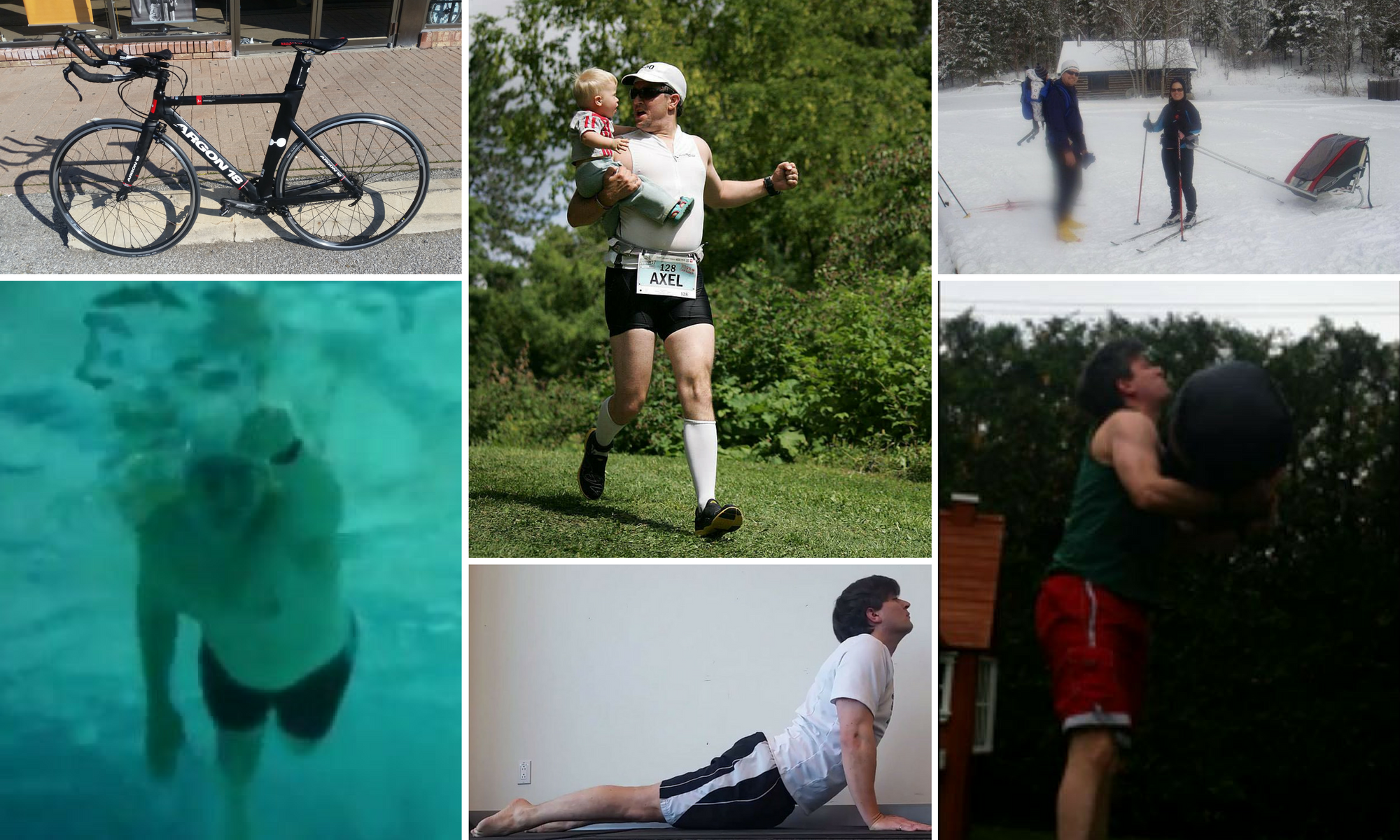
I announced in January that I had selected a training plan for the Barrelman Triathlon (Half-Iron). The plan is of a 27 week duration, meaning the start date of the plan was Monday March 16th. That falls right on our family ski vacation (recap to come), but as I had mentioned in my February Goals post, I’ve been implementing the structure of the ‘Basic Preparation Phase’ for nearly a month and a half. Here’s why this was a good idea.
Starting the Habit
For my program, Tuesdays and Thursdays had both swim and run workouts. The more of these I did, the more #TwoferTuesday and #TwoferThursday became the norm for me. Come those days, I was packing a swim-suit, running shoes, etc. It became a fact of life, and when the real program starts, I can put my concentration into what kind of swim and run workouts I’m supposed to have (speed, endurance, etc.)
Any formal training program should tell you what they’re assuming about your basic level of fitness and current training volume. These tend to be described in fairly general terms, but by pre-sampling the training program, you’ll have a better idea what you’re in store for at the outset.
Learning What Works/What Doesn’t
Tech
Doing triathlon training in February in Canada means a log of indoor work. Tracking treadmill runs, was a challenge since phone apps want GPS data (ditto a Garmin), but Samsung Gear Fit tracks well through step counting. BUT, not if the Samsung Health App is started through the phone. Endomondo pairs with my ANT+ Garmin HR strap, but the Samsung app doesn’t seem to, luckily, I still get some HR data through spot checks the Gear Fit makes.
Logistics/Scheduling
On one of my ‘twofer’ days that have a swim and a run, I opted to do a treadmill run and had asked my wife if it was OK if I did the swim in the evening after the kids were in bed which is usually “clean up the kitchen then quality time” time – then I wouldn’t need to do an early morning workout. Then, the Lightning Kid took forever to go to sleep (and asked for me) so what should have been an 8:00 departure turned into 8:30 or later. An evening workout runs the risk of making sleep difficult, and the truth is I was feeling exhausted (and I had the sense that a cold was coming on). I scrapped the swim in favour of rest, since getting sick would have sacrificed more than one workout, but the bigger takeaway is that mornings might be more practical after all.
The training program doesn’t seem to have much in the way of rest days, at least not in the early season. This may be a problem for a 40-something athlete like me, I may be able to work around it by turning some workouts into ‘active rest’. The best example might be substituting a Yoga class for a weights/strength session.
As of right now, the first week of the plan fell on the vacation in Vermont, and I got 3 hours 55 minutes of training volume done in a week that should have been 9 hours 30 minutes. Yet, thanks to having followed the basic structure for most of February and early March, I could pick up at week 2 without missing much, at least in theory. What I’ll do instead, is do Week 1’s workouts (since they have some time trialing that will be used to benchmark some of my paces and performance) then move to Week 3 and be in sync.
What’s Missing
What I didn’t do well during my pre-sampling, is get to know the different workouts. The table/spreadsheet has codes to classify workouts into different categories like time testing, endurance, speed, form, muscular endurance, anaerobic etc. and now that I’m in the thick of it, I find myself pressed for time to learn what I need to do for tomorrow’s (or even today’s) workout. I still haven’t transcribed everything into my own spreadsheet, but I should be OK until May or so.
Make sense? Or am I crazy (I love it when you call me crazy!)?